
Morningside Place recently held a Summer Fair to raise funds for the Alzheimer's Association. The event was full of fun for residents, staff, families and the local community. The event was covered by KSHB-TV:
It is the catch phrase of so many Alzheimer’s Association ads and articles:
“The first survivor of Alzheimer’s disease is out there.”
They are indeed. And we hope soon, because so many of us have lost a loved one to Alzheimer’s disease. Perhaps you are caring for a parent who has been recently diagnosed or is in the later stages of the disease. Regardless of whether or not Alzheimer’s has touched our lives, we all long for the day when a diagnosis of Alzheimer’s no longer turns a family’s world upside down.
To get to that day, however, much more awareness and involvement in the fight to end Alzheimer’s is needed. It is no coincidence that the Alzheimer’s Association chose June 21st, the longest day of the year, to launch activities, fundraisers and other opportunities for Americans to join in the fight to end the disease that impacts over 6 million Americans.
Public support is key to keeping the momentum going. Here are a few ways money from fundraisers and individual donations are used at the Alzheimer’s Association:
The Alzheimer’s Association has lots of ways to get involved, big and small. You can learn more about how you can help and organize others to help here.
Finally, we invite you to contact any of our Anthem Memory Care communities and learn more about sponsored walks and fundraisers how you can get involved locally.
The Alzheimer’s Association Longest Day website proclaims, “The day with the most light is the day we fight.” That fight is everybody’s business. So let’s all do our part. Together we can help find that first survivor!
(Our header image shows participants in the Willowbrook Place Walk to End Alzheimer’s in Littleton, Colorado!)
Related Articles:
Did you know that each year thousands of individuals aged 60+ experience abuse? If you find yourself shaking your head, you are not alone. Many Americans simply have no idea as to the extent of elder abuse occurring on a day-to-day basis. That is why we acknowledge June 15th as World Elder Abuse Awareness Day.
At our Anthem Memory Care communities we are very much aware of the importance of keeping our elderly population safe. So much so that it is part of our mission to “protect, engage and love” our residents. Furthermore, we believe that protecting our elders, especially those who are cognitively impaired, is everybody’s business.
So, what do you need to know?
First of all, it is important to understand that elder abuse is not always physical. The National Institute on Aging identifies several ways in which an older individual’s wellbeing can be compromised:
As hard as it is to learn about these horrific abuses, it is important to be aware of them. Most of us have an older relative or know someone who is reliant upon others for assistance and guidance. And we, too, may eventually have the same needs.
With that in mind, here are some resources to learn more about elder abuse and how you can do your part to help:
Finally, if you witness physical elder abuse, call 911. If you have a suspicion of abuse you should report it to the National Center on Elderly Abuse.
The generations of amazing individuals who have come before us deserve respect and dignity. They raised families, had skills and interests, and worked hard to make the world a better place for their children and grandchildren.
So, in addition to celebrating their lives we owe it to them to keep them safe and protected and to help ensure that they can continue to live their best lives, full of peace and joy.
Related Articles:
An Indy 500-inspired remote-control car race was held between students from AERO Special Education Cooperative and Grace Point Place Memory Care residents. Several of the residents are lifetime racing fans. And some very special friendships have developed between the students and residents!
The Reporter, a publication of Southwest Regional Publishing, covered the event, which you can read here.
Every June, the Alzheimer’s Association reaches out to encourage everyone to focus on spreading awareness and involvement in the fight to end Alzheimer’s disease. Our own Anthem Memory Care communities are actively involved in local activities and walks.
So, regardless of whether Alzheimer’s has touched yours or a loved one’s life personally, it’s important to be informed, spread awareness, and get involved.
First, know the facts.
Here are some basics about Alzheimer’s disease to share with your friends and loved ones:
Now it’s time to get involved in the fight to end Alzheimer’s.
The Alzheimer’s Association has all kinds of ways to connect with your local Alzheimer’s resources and action groups and do your part to spread awareness. Here are three to get you started:
Finally, feel free to reach out to any of our communities.
Many of our team members have personally experienced Alzheimer’s within their own families. We understand the challenging journey you and your loved one are taking. And we’re here to help!
Related Articles:
For our Anthem Memory Care communities, May has been a month full of great outdoor activities.
After a long, turbulent winter it’s been nice to be able to count on more sunny, warmer weather. Our residents and staff love to get outside and enjoy experiencing nature in full bloom. And this is so important for individuals living with dementia. The sweet scent of a rose garden, the touch of leaves and soft petals, or simply the feel of a cool breeze can have a calming effect, while delighting their senses. And, it may even spark a memory or two.
That is why we take every opportunity to bring our residents together with nature. Whether it’s to plant, arrange flowers, visit a park, take a walk, or just sit in the sun and soak up Vitamin D, nature brings a special kind of therapy. And it can be powerful!
Below are some images of residents and staff enjoying a few of the many activities that bring them together with nature and stimulate the senses.
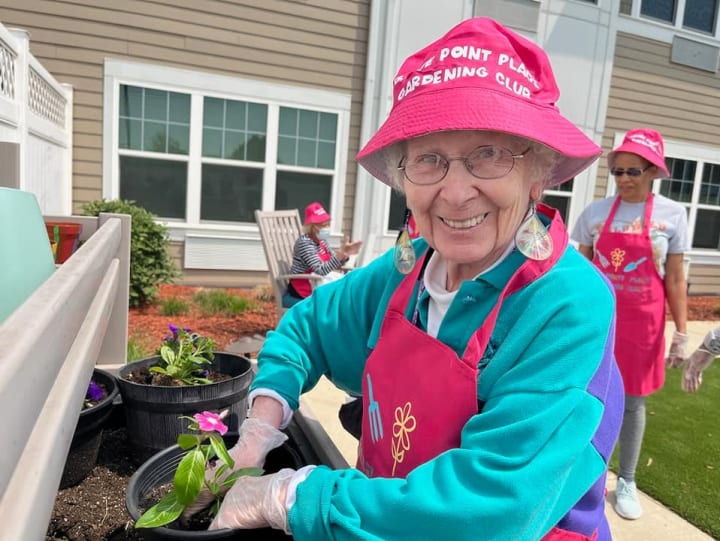
This delightful member of the Gardening Club at Grace Point Place in Oak Lawn, Illinois enjoys working with the soil and nurturing the beautiful flowers.
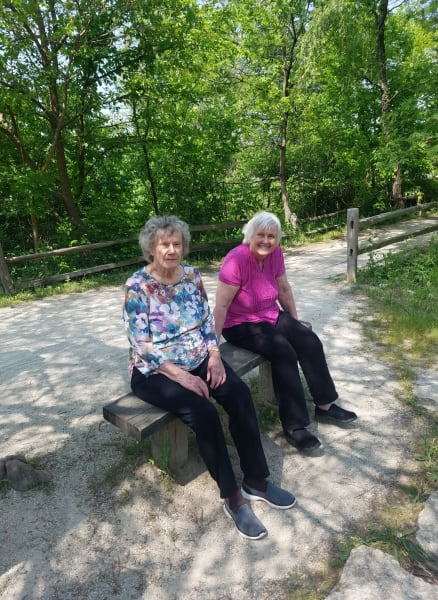
Time to sit and enjoy a cool breeze for these residents of Harvester Place in Burr Ridge, Illinois. This was taken at The Little Red Schoolhouse Nature Center.
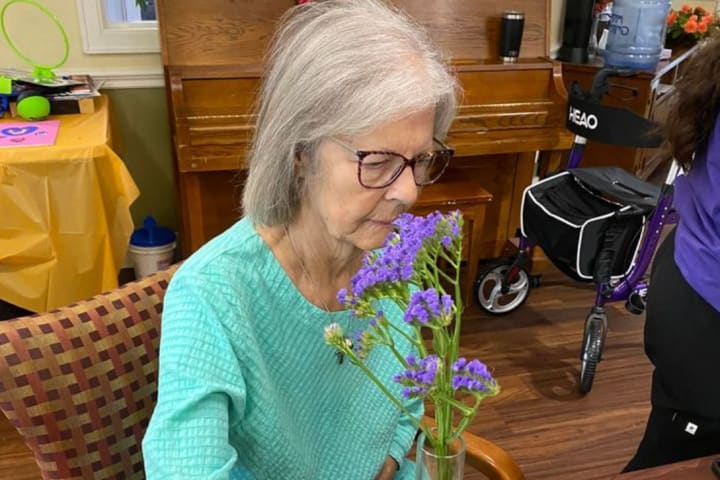
While arranging flowers at Chisholm Place in Wichita, Kansas, there is always time to stop and take in their wonderful scent!
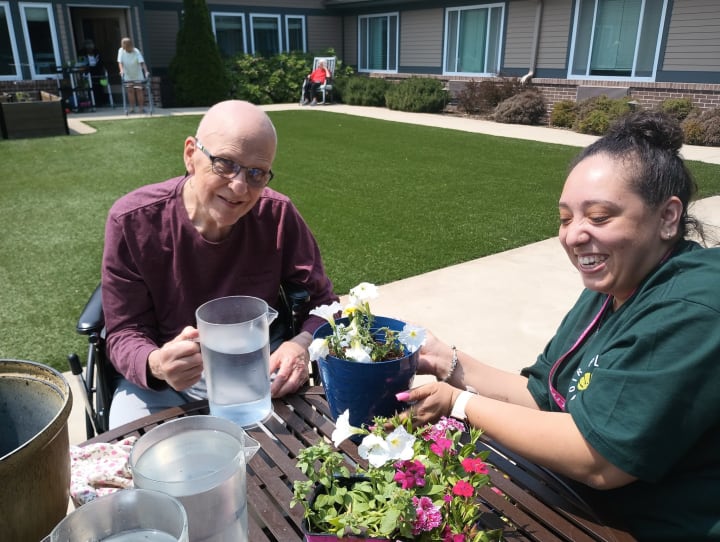
Organizing the petunias before transferring them to the outdoor planters at Porter Place in Tinley Park, Illinois.
For those who are caring for a loved one with dementia, think about what activities you can enjoy with them outdoors. Also, look for ways to bring more of the outdoors inside. Cutting and arranging flowers from the backyard or bringing in a store-bought bouquet help your loved one enjoy the scent and feel of the flowers. It can also bring a heightened sense of wellbeing and tranquility, something we all need in our lives!
(Our header image is of the Grace Point Place visit to the Cal-Sag Trail.)
A group of eight volunteers with the McDonald’s Corporation recently visited Harvester Place to help residents plant their flower gardens.
Danyanique Hughes, life engagement director, explained how beneficial the project was for the residents. “Working side by side with others in the earth is energizing for all of us, and making new friends is an added bonus.”
You can read more about the event in the Daily Herald.
For the first time since the pandemic, the "senior prom" is back at Morningside Place Memory Care in Overland Park, Kansas. It is a fun opportunity to get dressed up and break out the dance moves. Chasity Robinson-Mwangi, community relations director, noted how much the residents enjoy the event. They even crown a king and queen!
Local Fox Channel 4 covered the big event which you can watch here: https://fox4kc.com/video/a-different-kind-of-senior-prom/8658643/
May is Mental Health Awareness Month, a good time to reflect on things family caregivers can do to maintain good mental health for themselves as well as their loved ones who are challenged with dementia, such as Alzheimer’s.
You may be interested to know that there is a link between mental health and dementia. A study co-funded by the National Institute on Aging (NIA) was published in the Journal of the American Medical Association (JAMA) Psychiatry analyzed the mental health records of 1.7 New Zealand citizens over a period of thirty years.
The study found that mental disorders developed in an individual’s youth can lead to a greater risk of dementia. Furthermore, the study found that intervening at an early age to treat mental disorders and issues, such as anxiety, can potentially decrease the risk for dementia later in life.
So, whether you have been diagnosed with dementia or you are caring for someone who has, taking actions every day to care for your mental health and wellbeing can help keep your mind as healthy as possible for as long as possible.
The National Institute of Mental Health (NIMH) has published tips to promote mental health that everyone should follow. We’ve paraphrased 5 of them as follows:
Mental health awareness deserves to be practiced, not just every May, but every month. That includes family caregivers as well as individuals diagnosed with dementia. Becoming more self-aware and following the above tips can make a positive impact on a daily basis and bring greater emotional wellbeing for all the challenges of life ahead.
During National Nurses Week, staff of Porter Place Memory Care honored two former nurses, who are now residents, with special certificates thanking them for their service over the years. Sandra Schaaf, an OB/GYN nurse and Jean Lintner (pictured above), an elder care nurse, were presented with the certificates along with special nurse-themed charm bracelets.
The local Tinley Park Patch covered the story, which you can read here.
Did you know that individuals living with Alzheimer’s often find it easier to express themselves and even spark memories through art? Why is this? We know that with Alzheimer’s, cognitive ability such as verbal communication becomes increasingly impaired. However, the process of putting paint on a canvas can serve as a release in terms of unlocking memories and communicating emotions that are harder to articulate for individuals with dementia.
It’s an amazing phenomenon, but a very real one. That is why expression through art has been used in countless therapeutic settings to help individuals express themselves who might otherwise be unable to do so.
Tapping into the therapeutic value of art, the Alzheimer’s Association launched a program ten years ago called Memories in the Making, which is centered on encouraging individuals in early to mid stages of Alzheimer’s to pick up their paint brushes and submit their artwork for possible inclusion in their local chapter auctions. The proceeds go to support Alzheimer’s research.
The program has gained steadily in popularity throughout memory care communities nationwide. This includes our own Anthem communities, such as Highline Place in Littleton, Colorado, whose residents, families and staff look forward each year to celebrating the artistic talents of the residents. And there is plenty to celebrate!
They recently shared some of the amazing artwork produced by residents. Their exhibit included the stories of the artists, one a former Broadway actress!

The Wild Blue Yonder by Emily Warner, a former airline pilot!
Emily’s bio is below:

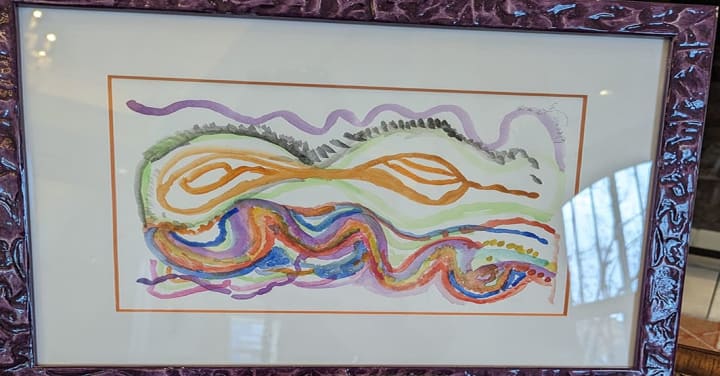
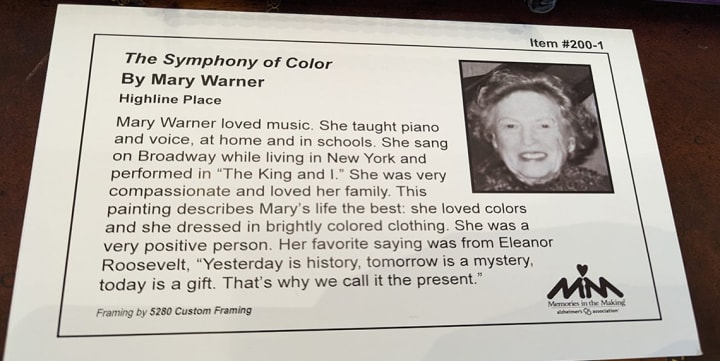
A Symphony of Color by Mary Warner, a former Broadway actress!
Mary’s bio is below:
Highline Place has been participating in the Memories in the Making program almost since its inception ten years ago. And they are proud to say that they have had at least one of their participants chosen for the local Alzheimer’s auction every year. This year, they had three!
If you are caring for loved one with Alzheimer’s, getting out the watercolors and a clean white canvas just might be the catalyst to help them express themselves in ways that are easier than the frustration of trying to find the right words. And why not pick up a brush and paint alongside them? Art therapy is for everyone!
(Our header image shows additional artwork on display for Memories in the Making. We are continually impressed by the talent inside our Anthem communities!)
May is Huntington’s Disease Awareness Month. Most of you have probably heard of Huntington’s but, unless it has impacted your family directly, you may not really understand the disease.
The official definition, according to the Mayo Clinic, is that Huntington’s is “a rare, inherited disease that causes the progressive breakdown (degeneration) of nerve cells in the brain. Huntington’s disease has a wide impact on a person’s functional abilities and usually results in movement, thinking (cognitive) and psychiatric disorders.”
While Huntington’s disease does share some common characteristics with Alzheimer’s disease, there are several striking differences:
What does Huntington’s disease have in common with dementias, such as Alzheimer’s disease?
It is important to know, however, that there are resources available to arm families with information they need to better understand Huntington’s disease and make the best decisions for their loved ones. Here are a few:
Huntington’s Disease Society of America
Huntington’s Buzz: News and Research
While Huntington’s disease is not curable, as with Alzheimer’s it is possible to use resources available to provide an enriching, supportive environment with health and safety precautions in place to help individuals with these diseases to live their best lives for as long as possible.
Related Articles:
Something many of us take for granted is our mobility. For most able-bodied Americans, getting up and walking to the fridge or getting out of the car and walking into a store is just a part of our daily activities.
But maintaining mobility becomes precious to us as we age. Stiff joints, sore muscles and other issues can make getting up and out more challenging. That’s when we begin to look for ways to preserve what we still have and slow the progression of health issues that impair our mobility.
Alzheimer’s and other dementias can affect the areas of the brain responsible for muscle coordination and balance. That creates a double whammy for older individuals who may already be experiencing age-related mobility issues. If you are caring for a loved one with dementia you may have begun to notice that their gait has become more unsteady. This increases the potential for falls which can cause serious damage.
And yet, keeping them seated out of concern they may fall is by no means a good alternative. Remaining sedentary for long periods of time can lead to other issues such as poor circulation and loss of muscle tone. It can also cause an individual to lose their sense of independence which, in turn, can lead to a feeling of isolation and ultimately depression.
Here are three steps caregivers can take for a loved one with dementia to help alleviate issues surrounding a decrease in strength, balance, and muscle coordination:
Fortunately for our residents, Anthem Memory Care communities were built from the ground up to cater to the mobility challenges of aging individuals with dementia. Our hallways are wide and light and easy to navigate forming a large circle throughout our building. Our courtyards have clean, even walkways and steps that are easy to see.
With a little effort and attention, you can help your loved one maintain their mobility as long as possible. By keeping their environment safe you will help make them feel more confident in getting up, walking, exercising and keeping their body as strong as possible, for as long as possible.
April is Occupational Therapists Month and, as far as we’re concerned, it should be every month!
Occupational therapists and occupational therapist assistants (OTs and OTAs) provide a valuable service to residents living in senior care. We know because our communities partner with some of the best in the country.
Here are a few of the vital tasks these talented and dedicated individuals perform inside memory care communities:
A great example of the amazing work OTs do is Robin Vigil, a certified occupational therapist assistant with Legacy Healthcare. Robin has been working with Highline Place Memory Care in Littleton, Colorado since they opened their doors.
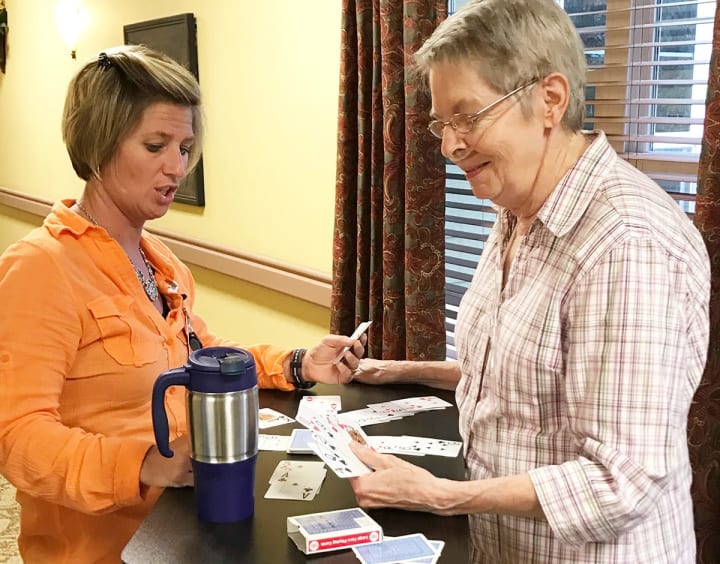
This impromptu game of cards is a great way of assessing a resident’s cognitive skills. Robin is especially good at gathering this information while engaging with residents in a way that is positive and fun.
Sharing a few more photos of some amazing OTs and OTAs doing what they do so well inside our communities.

Mary Gessler, certified occupational therapist assistant at Morningside Place Memory Care in Overland, Kansas, engages residents in a baking session. She knows that many residents who once enjoyed baking and cooking for their families respond well to continuing to spend time in the kitchen of their memory care community.

Here a resident of Liberty Place Memory Care in West Chester, Ohio enjoys working alongside occupational therapist, Lynnette, to plant and nurture flowers for the community. Planting is a purposeful activity for individuals with dementia, helping to stimulate the senses and connect with nature.
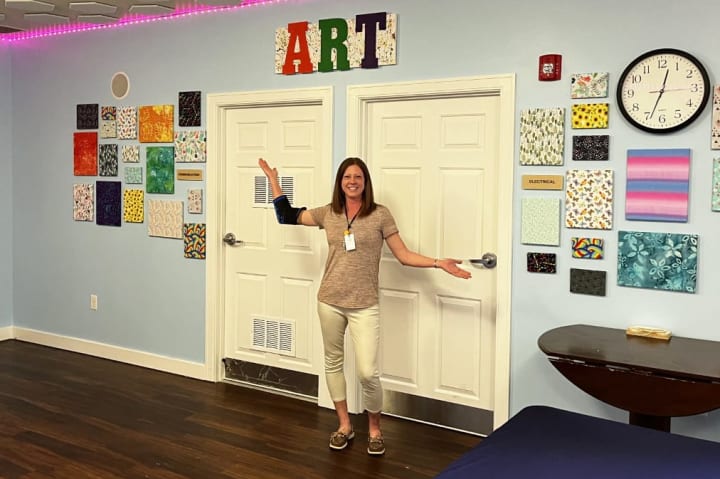
Another Morningside Place occupational therapist, Trish Miser, strikes a pose in her favorite room, where she regularly engages residents in art activities. This is a meaningful outlet for residents to express themselves. Often talents from younger years continue to remain strong for residents. The results can be powerful.
While there may not yet be a cure for dementia, our OTs and OTAs are making a difference every day in the lives of our residents, working with our teams to optimize the daily life experiences of our residents.
We salute you!
(Our header photo shows Highline Place’s Robin Vigil and a smiling resident posing with their cowgirl hats!)
Related Articles:
Vineyard Place Memory Care residents spent time recently reading and engaging in fun activities with local Cole Canyon Elementary School pupils. Everyone enjoyed the session. These inter-generational activities are so beneficial for both the residents and the children!
The activities were covered by the local Press-Enterprise. You can read the full story here.