
Many of our Anthem Memory Care residents and staff love fall because it brings cooler weather and the promise of holidays ahead. Fall ushers in a broad spectrum of opportunities for activities that are unique to the season.
Decorating our rooms and hallways with colorful leaf displays, visits to pumpkin patches, and planning Oktoberfest events are just some of the things we all look forward to. And, as our residents engage in these activities, we have found that they often spark memories relating to their own past experiences with their children and families.
In that spirit, we’d like to pass along some fall activity ideas that you can enjoy with all your family members, including loved ones living with dementia.
Our residents love all of these activities, but perhaps you can add to this list with special fall-themed traditions in your own family. Taking time to enjoy these activities benefits everyone in the family, young and old.
Don’t hesitate to contact any of our Anthem Memory Care communities for more ideas or to get information and caregiver resources. We welcome you to drop by and visit a community near you and learn more about our many activities and events tailored to bring purpose and meaning to the lives of our residents.
(Our header image shows a talented resident of Chisholm Place Memory Care in Wichita, Kansas showing off her beautiful fall wreath!)
Would you climb Mount Everest to support a good cause?
We know of two people who would, without hesitation, answer with a resounding “Yes”! Because they did it!
In August, Anthem’s co-principals, Isaac Scott and Lewis McCoy participated in the “Everesting Challenge”, a rigorous climb up Utah’s Mount Ogden from the Snowbasin base lodge to the peak. To achieve the ultimate goal, hikers make the vertical climb thirteen times over a 36-hour period. Isaac and Lewis were up to the challenge, with a total hiking distance of 29,029 vertical feet. And that is the equivalent height of Mt. Everest from sea level!
Climbing for a cause
However, for Scott and Lewis, the climb wasn’t just about personal gratification. It was to support a cause, one that we believe should be important to all operators of memory care communities. The Everesting Challenge climb was part of a program to raise awareness and funds for the Anthem Memory Care Employee Resource Fund.
This new program has been put together to support the needs of the very special individuals who provide daily loving care for our Anthem Memory Care residents. It will provide funding for employees who may need extra financial help from time to time as well as help ease the burden of paying for their own educational goals as well as things like school supplies for their own children.
Dedication to supporting our caregivers is central to our core values.
Our Anthem Memory Care mission is to “protect, engage, and love” our residents. That goes for our employees as well. At our Anthem communities we consider our caregivers as part of the Anthem family. But we also realize that they have families of their own, along with aspirations for their own personal and professional growth and that of those they love.
We are excited about the Employee Resource Fund and will continue to raise awareness as well as raise funds to support the program. You can learn more about the fund and other fundraising events by contacting any of our Anthem Memory Care communities.
Concord Place Memory Care recently celebrated a very special 100th birthday for resident, Gerald Lay. An Army veteran of World War II, Mr. Lay also enjoyed a successful career as a civil engineer.
He took time out of the celebration to share some words of wisdom: "Take things slow and enjoy life while you can.” Happy birthday, Gerald Lay! The event was covered by local TV Channel WVLT in Knoxville. You can watch the full video here.
According to data from the National Institute on Aging, one in four of individuals age 65 or older falls each year.
For seniors, especially those living alone, a fall seems to be always around the corner waiting to happen. It lurks in almost every corner of the home, as well as in the backyard and throughout the neighborhood. A fall can happen anywhere, and victims can end up with anything from a bruise or cut to a broken hip or even a life-threatening head injury.
Individuals with dementia are especially vulnerable to falls. That’s because it dementia causes a combination of cognitive and physical issues that make it more difficult for the individual to complete simple actions that they have done all their lives. That includes walking.
The culprit? Brain damage.
Individuals with dementia experience escalating damage to the motor and premotor cortex, the limbic system, and the basal ganglia of the brain. To coordinate brain signals from the brain to the muscles, all must work together. That is what enables an individual to do things like sit down, get up from a chair, turn around and walk. But when this complex network of signals and muscle response fails, even slightly, the result is often a fall.
Did you know that falls can differ depending on the type of dementia?
Many families don’t realize that the movements associated with a fall can differ depending on the type of dementia an individual has. It will also affect the nature and direction of the fall As an example, Alzheimer’s often involves a fall back into a chair when an individual attempts to get up. Individuals with Lewy Body disease or Parkinson’s dementia may experience a hard fall forward or backward resulting from a sudden stiffening of the body often accompanies by a loss of consciousness. The National Institute on Aging and the Itty Bitty Dementia Book by Dr. Tam Cummings explain in greater detail how the type of dementia may impact the fall.
The best way to handle a fall is to prevent one.
Here are some areas to focus on to help prevent your loved one from taking a bad fall:
Memory care communities work to reduce falls 24/7.
No one understands the link between dementia and the risk for falls better than professional caregivers in memory care communities. Safety must always be one of their top priorities and it is why so many families make the decision to transition their loved ones with dementia into memory care.
Our own staff at our Anthem Memory Care communities are trained to recognize the physical manifestations of each stage of dementia and recognize the triggers and warning signs of a fall. They work with residents to optimize their mobility and retain it for as long as possible. We incorporate a range of mobility aids as well as visual cues to help avoid confusion that could precede a fall. This includes strategically placed handrails, color coded pathways, signage, and flooring with non-glare coating.
While there is no guarantee that you can prevent a fall, you can improve the odds!
If you are caring for an aging loved one who is beginning to experience mobility issues, now is the time to arm yourself with information and gather the necessary tools to optimize their mobility and keep them safeguarded against activities and obstacles that can lead to a fall.
Feel free to contact an Anthem Memory Care community near you. We’ll be glad to answer your questions and share our resources with you. We’re here to help!
Residents of Chisholm Place Memory Care recently crafted keychains, bracelets, and coasters as part of a fundraiser in honor of a local firefighter, Ty Voth, who was killed in the line of duty. The residents are committed to giving back and supporting their local community. Participating in charitable acts like these bring added purpose and meaning to their lives as well as those they are supporting through their efforts.
The funds raised were donated to the Wichita Firefighters Charitable Fund.
The fundraiser was covered by local Wichita station KAKE. You can watch the video here.
Once an artist, always an artist and no one knows this better than talented artist, Gail Taylor, resident of Vineyard Place Memory Care in Murrieta, California.
Taylor’s artwork has been featured in books and has been displayed in hotels and hospitals all over the country. Her signature works have depicted leaves cast in metals, such as copper. She accomplishes it by dipping the leaves in liquids and positioning them on copper plates. They are beautiful works of art and residents of Vineyard Place were excited to have some of these works displayed in their own exhibit.
The event was covered by the Press Enterprise. You can read the full article here.
Residents and local seniors competed for the crown at Greenridge Place Memory Care. Residents and staff had a blast creating scarves and hats for the show. Contestants performed and walked the runway to enthusiastic rounds of applause, until the final moment when former Mrs. Senior Colorado crowned the winners. It was a fun and engaging event for all who participated and attended!
The event was covered by local TV station, KDVR and you can watch the video here.
Lucille Noble, a 102-year-old resident of Pinnacle Place Memory Care in Little Rock, Arkansas, was taught to fish by her father as a child growing up in Thida, Arkansas. Pinnacle staff wanted to give her and Biff Morgan, another Pinnacle Place fishing aficionado, a chance to unleash their skills at the Bass Pro Shop pond. Guided by a Bass Pro expert, they had a blast telling stories about earlier days and enjoying the experience all over again.
The fishing expedition was covered in an article by local Little Rock Patch, which you can read here.
Families with loved ones diagnosed with Alzheimer’s disease are often left with more questions than answers. In many cases this is because their lives have been turned upside down by the news and they are struggling to gain control over their situation. It isn’t easy.
This is why it is critical for families to have access to solid information. They need answers to their immediate questions, a greater understanding of what is happening to their loved one, and tools to pave the way forward. Being armed with information will also help support decisions on how to handle their loved one’s needs, now and in the future.
It begins with an understanding of the stages of Alzheimer’s. And there are more than you think.
One area that often gets glossed over is a comprehensive description of the stages of Alzheimer’s. Most families have a vague understanding and often generally describe it as early, middle, and late stages of the disease.
In fact, there are seven stages of Alzheimer’s disease, as outlined by the Global Deterioration Scale. And each is important to understand. We have summarized them below:
Why is it important for everyone to understand all of the stages?
Understanding all seven stages of Alzheimer’s brings several benefits. First, it sheds light on the fact that many older individuals may already be in the early stages of dementia and yet have not been properly screened. Unfortunately, that is why most diagnoses aren’t made until an individual is already in stage 3, mild cognitive decline.
An early diagnosis brings more options, such as clinical trials and treatments which can delay the progression of dementia. Understanding the mid to later stages helps families better cope with the many cognitive, behavioral, and physical changes. It will help them tackle these challenges with open eyes as they present themselves. Finally, having a good understanding of the progression of the disease through later stages will help them plan for the future as their needs change.
If you are caring for a loved one and suspect that they may be in an early stage of dementia, encourage them to undergo testing. Medicare will pay for early screening and testing as well as many of the treatments available to slow the progression of dementia. But you must take action early to optimize those benefits.
The more you know, the better you can serve your loved one’s needs … and yours as well.
We encourage you to reach out to any of our Anthem Memory Care communities to learn more about Alzheimer’s and other dementias. Our experienced, caring team will be happy to sit down with you and answer your questions as well as provide you with additional information and resources.
A diagnosis of Alzheimer’s brings many challenges to families. Understanding each stage and being armed with accurate information will help you navigate the road ahead. And remember, we’re here to help!
Our Anthem Memory Care communities are constantly involved in fundraisers or other acts of charity within their greater communities. Giving back is so important and many of our residents have been service oriented all their lives. We like to help them continue their tradition of donating their time and energy to support a good cause.
The act of working together to help those in need brings many benefits to individuals in general, especially to those living with dementia. Some of these include:
The charity events and projects at our communities are revitalizing for our residents. Everyone gets excited and energized to contribute to each good cause we support. And there are many!
Below are just a few of our charity events:

Morningside Place Memory Care in Overland Park, Kansas holds a car wash to raise funds for The Alzheimer’s Association.

Liberty Place Memory Care in West Chester, Ohio made Easter Baskets for the children of Reach Out Lakota

Willowbrook Place Memory Care in Littleton, Colorado donated blankets to local animal shelters.
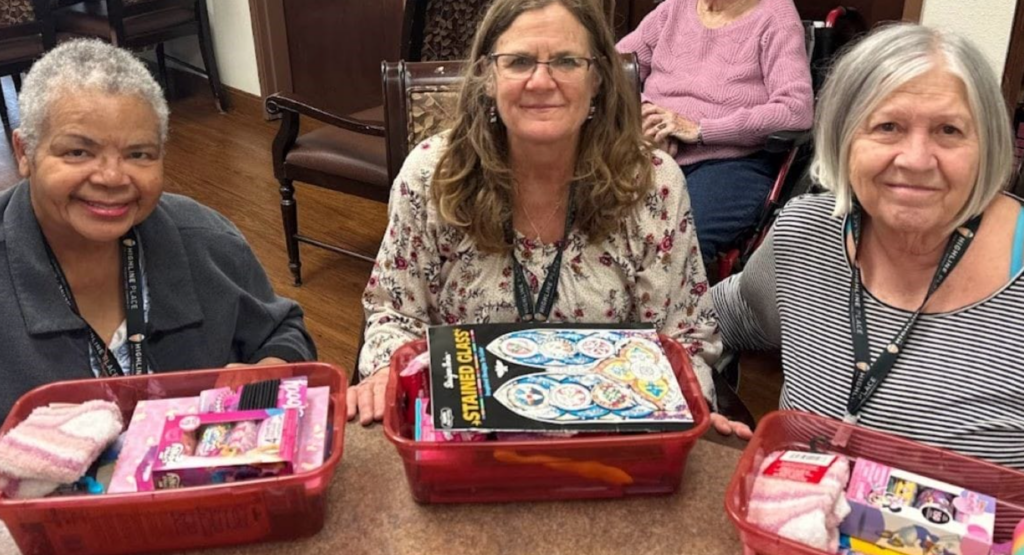
Highline Place Memory Care in Littleton, Colorado puts special gift packages together for Operation Christmas Child.
If you are a family caregiver for a loved one with dementia, look for local charities with programs you and your loved one can participate in. There are plenty of opportunities to donate and contribute to worthy causes.
Regardless of which charity or how actively you involve your loved one, your charitable acts will not only lift your spirits but give you both something positive to share, along with the feeling of accomplishment donating your time to a worthy cause brings.
If you need more ideas or are interested in how to get involved in local charities, reach out to any of our Anthem Memory Care communities. We’d be happy to share our experiences and ideas with you and your family.
(Our header image is of Emerald Place Memory Care residents and staff showing off their special dog bandanas of love to gift to their local animal shelter in Glenview, Illinois.)
While many don’t realize it, the experience of grief does not belong solely to those whose loved ones have died. Grief can occur in other life experiences. One of them is caring for a loved one as they pass through the stages of dementia.
Grief expert, professor, and author Kenneth J. Doka remarks, “Grief has been identified as the constant yet hidden companion of dementia.” How true that is.
Often described as “ambiguous grief”, the grief associated with caring for an individual with dementia is unique in that it comes and goes in waves as a loved one’s state of dementia present new emotional challenges and the caregiver witnesses their loved one slipping away from the person they have known and with whom they have shared a life.
For those caring for a loved one with dementia, it is important to understand that, as difficult as it is, your grief is normal. You may also be experiencing the companions of grief: anger and guilt. Together, these feelings create an emotional rollercoaster that can be overwhelming.
Education can help caregivers to better tackle these feelings. First let’s start with the Alzheimer’s Association’s 5 stages of grief:
These stages of grief may occur in any order as the stages of dementia continue to impact your loved one’s memory and behavior and how you relate to them. You will move in and out of each stage over time.
Understanding this ambiguous form of grief is just the beginning of the caregiver journey. There are things that all family caregivers can do to take care of themselves and build a foundation of inner strength to help navigate the road ahead.
The Alzheimer Society in Canada has published some great tips that we’ve summarized below:
You can access more tips and information from the Alzheimer Society here. You can also access videos and other information on our Anthem Memory Care resources page.
It is important for family caregivers to above all be patient with yourself. Treat yourself well. When others offer to help, accept their help. Caregivers are some of the most selfless, dedicated individuals around. We know because we talk with them every day.
The grieving process for caregivers of loved ones with dementia is unlike any other. Every caregiver’s journey is as unique as their own circumstance. In all cases, however, understanding the many valid emotions that ebb and flow during that journey is essential to living each day as it comes and finding moments of peace and understanding along the way.
Feel free to reach out to any of our Anthem Memory Care communities. We understand the challenging journey you are on and we are here to help!
We are proud of all our Anthem Memory Care Communities for living each day our mission to “Protect, Engage and Love” our residents.
The latest example of this is Grace Point Place Memory Care in Oak Lawn, Illinois. Like all of our Anthem communities, the residents, staff and families are active within the greater community, joining with youth groups, local charities, and other organizations to help drive purposeful events and outreach programs. Not only do they help the community, they also give residents a sense of purpose and belonging.
Our executive team recently visited Grace Point Place to celebrate their 100% occupancy achievement. We are so proud of everyone who contributes to the excellent reputation enjoyed by Grace Point Place and their ongoing commitment to residents and families.
So, how does a community keep their suites full of well cared for residents and keep the brightest caregiving talent looking after them? Here are just some of the reasons we believe our Anthem Memory Care communities consistently strive to rise to excellence:
Finally, we believe that any organization should be much more than a logo and tag line. You may have noticed the flame in our Anthem logo. It has meaning to everyone who lives and works within our doors. The Anthem flame represents the Holy Spirit, individual spirit, and community spirit, each of which anchors our personal and professional values. The name “Anthem” represents a song of praise and loyalty to the people who live and work in our communities. The Anthem lamp lights the pathway forward to connect residents to their families and the world around them.
We invite you to visit any of our Anthem Memory Care communities and witness for yourself the many spontaneous moments of joy that flow organically through the genuine relationships formed between residents and with our wonderful staff.
Congratulations to everyone who had a part in helping Grace Point Place Memory Care attain 100% occupancy. And to all our other Anthem communities who are also thriving!
The nagging concern often starts when a parent or other loved one starts forgetting the simple things such as where the coffee is kept or how to navigate a familiar route to the grocery store. Or perhaps they begin asking the same questions over and over again. At some point it becomes harder to ignore. Could it be Alzheimer’s? What to do next? It’s a scary thought. So, all too often the nagging doubt continues to be pushed aside.
While hesitating to act is certainly understandable, it is also the reason why so many individuals are not diagnosed until they are well into the disease. And early detection could bring them several advantages. Medications are more effective in the early stages of dementia. There are more opportunities to participate in clinical trials. And there could be more time to organize financial and legal plans.
If you have a family member whom you suspect may be developing dementia, here are some important steps to take to turn your concerns into positive actions.
First, know the ten signs of dementia, summarized below (read full descriptions from the Alzheimer’s Association here):
Take notes of behavior from your loved one that lies outside their “norm”. Include as many details as possible. Dr. Tam Cummings, gerontologist and dementia expert has tools to help you evaluate your loved one’s behavior. The ones to focus on are:
You can access these tools here.
Discuss your concerns with your loved one. This can be challenging, so find a time when you are both relaxed, and you have time. Don’t rush this conversation. Refrain from using authoritative phrases such as “I think you need to” or “You’re forgetting things”. There is no need to mention Alzheimer’s or dementia at this point. Instead use phrases such as “I thought I noticed that you were having a hard time remembering…”. Then, cap off each statement with “What do you think?” And stop to listen. You may find that he or she is relieved to be able to talk about their memory lapses.
Share your concerns with family members. Getting their support early on is important for the journey you may be facing ahead.
Arrange for testing through your loved one’s physician. If you have taken notes based on use of diagnostic tools, such as those provided by Dr. Tam Cummings, be sure to send your notes to the doctor in advance of the appointment. The doctor will conduct some preliminary tests and can arrange for a more extensive exam. Medicare will cover these costs.
Familiarize yourself with the latest research and treatments for Alzheimer’s disease. Do this for your own benefit as well as for any conversations you have with your loved one and other family members. The more informed you are, the more help you will be to yourself and others. Our Anthem Memory Care resource page contains information, webinars, and links to a variety of additional resources.
Begin with knowledge and facts on your side.
If your loved one does receive a diagnosis of Alzheimer’s, taking the steps on this list will help arm you for your discussions with your loved one, your family, and physicians. And taking action will give you a greater sense of resolve and control, both of which will be helpful for the days ahead.
Of course, nothing can truly prepare us for something as daunting as an Alzheimer’s diagnosis. But if and when one is given to your loved one, being prepared will make a big difference.
We invite you to reach out to any of our Anthem Memory Care communities with questions and concerns. We will be happy to answer your questions and help you find additional resources.
When a loved one is diagnosed with dementia and starts showing signs like unusual behavior and memory loss, it can be a confusing and overwhelming time for families. Why can't Dad remember how to get to his doctor's office? Why is Mom acting so strangely in public? These changes can be hard to understand and navigate.
The reflexive action is to say, “You don’t remember where the doctor you’ve been seeing for 25 years is located?” Or, “Mom what are you doing?!”
Part of that reaction comes from the fact that humans are natural teachers. Dr. Tam Cummings, gerontologist and dementia expert notes that this innate desire to teach is why we will, almost without thinking, correct someone or fill in a name that someone has forgotten.
That is also why a family member becomes frustrated when correcting a loved one who continues to insist they have not said or done anything that needs correction. It is not that they are deciding to be stubborn. Nor are they joking around. It is a manifestation of the changes occurring in their brain as a result of Alzheimer’s disease or another form of dementia.
There is a name for what that person is experiencing. It’s called anosognosia.
What do caregivers need to know about anosognosia?
Because Alzheimer’s is a brain disease that gradually kills brain cells, access is cut off to the areas of the brain (think of millions of rolodex files) that enable an individual to recall names, places, experiences and faces. It also cuts off areas of the brain that govern behavior.
According to the Cleveland Clinic, experts estimate that anosognosia affects more than 80% of people with Alzheimer's disease.
What are the symptoms of anosognosia?
According to the Cleveland Clinic, an individual with anosognosia can’t do one or more of the following:
In some cases, the individual may avoid the truth of their condition by rationalizing what’s happening to them or attempting to cover up symptoms. Some may confabulate, which means that their mind fills in the gaps with false memories. This can be done either consciously or without realizing it.
If you are a family caregiver, understanding the dynamics behind anosognosia will help make it easier to understand why mom may still think her deceased husband is still alive. Or why dad may take food off someone else’s plate, something he wouldn’t dream of doing before.
How can you improve communications with a loved one with dementia?
The first step to engaging successfully with a loved one with dementia is to lean into their reality. This is also the most challenging step, and one you can’t expect to take overnight. However, understanding that it is a brain disease and not your loved one’s fault can make taking that step a bit easier.
Here are five tips that will lead to better communication and engagement:
Ongoing education is so important for family caregivers of individuals with dementia. We urge you to tune into Dr. Tam’s webinars on topics of dementia. The information you gain and tips you learn will help you navigate the road ahead. Be sure to share your resources with family and friends so that they, too, can understand anosognosia and learn how to adjust their own communication skills and attitude.
Anosognosia is a difficult reality to accept for families. It involves weaving oneself into the new and very different reality of the loved one with dementia.
Our Anthem Memory Care communities encourage you to reach out to us for more information and to answer questions you may have. We know that the road ahead will be challenging. And we’re here to help!
Most people engage in routine behavior. It may be a morning routine such as getting up, letting the dogs out, and sitting down for your morning cup of coffee. For others it may be an after-dinner walk or a weekly call to a friend or family member.
We gravitate to routines because they have a calming effect, bringing a sense of order to what might otherwise be a hectic, stressful day.
For individuals living with dementia routines carry even more importance. In a world where life has become overwhelming and confusing, having a routine creates a familiar pattern of behavior that can be relied upon.
If you are a family caregiver for a loved one with dementia, you can help reduce stress by incorporating some healthy routines into their lives.
Here are five key benefits of routines for individuals living with dementia:
Establishing routines can also be beneficial for caregivers. By creating an environment that includes routines, you have assurance that, even on a stressful day, there is time set aside to take a breather and re-charge your own energy levels.
What are some good routines families can follow to optimize quality of life for their loved one?
Make sure that the activities you choose are well within the ability level of your loved one. You may find the need to adjust them as their condition progresses.
The most important thing about establishing routines for your loved one with dementia is maintaining them. It may not always be easy in that situations are bound to come up that disrupt your daily pattern. However, with effort and patience you will find that these routines are a loving way to establish a sense of order in both your lives. And both of you will benefit.
For more caregiver tips and information about dementia, please visit our Anthem Memory Care Resource Page.