
How is your summer going? It’s one of our favorite times of the year at our Anthem Memory Care communities. Not only does the weather permit more healthy outdoor activities, it is also a time for relaxing with residents, families, and friends.
Our residents love to reminisce about their own family summer traditions and vacations. And we love hearing their stories. Summer is also a time to make more memories, and we so enjoy sharing each new experience with them.
Below are just a few of the many activities our Anthem communities have been enjoying this summer:

Cascade Creek Memory Care in Rochester, Minnesota enjoy their “Summer of Service” program with local middle school students. Intergenerational activities bring benefits to both young and old.

Golf-loving residents of Willowbrook Place Memory Care in Littleton, Colorado hit the driving range to practice their swings. Many residents have been golfers all their lives and love showing off their skills.

Rawdah Homeschool students join residents of Churchill Place Memory Care in Glen Ellyn, Illinois for an afternoon of pinwheel making and great conversation.

Porter Place Memory Care residents had a blast at their annual car wash to raise funds to fight Alzheimer’s disease. Great fun for a great cause!
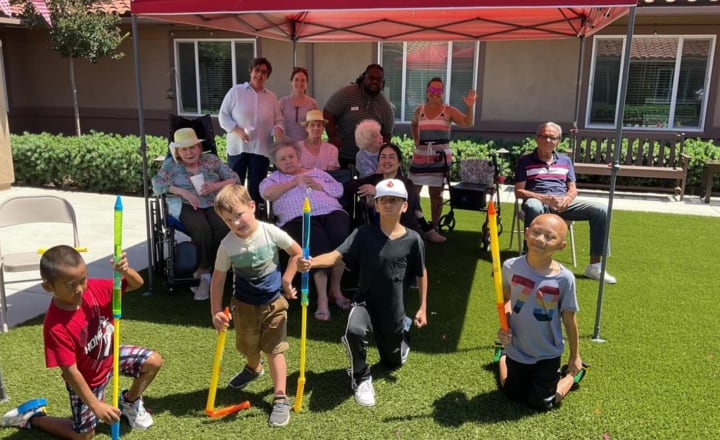
Vineyard Place Memory Care in Murrieta, California hosted local school kids for a day of outdoor activities, topped off with a delicious picnic.
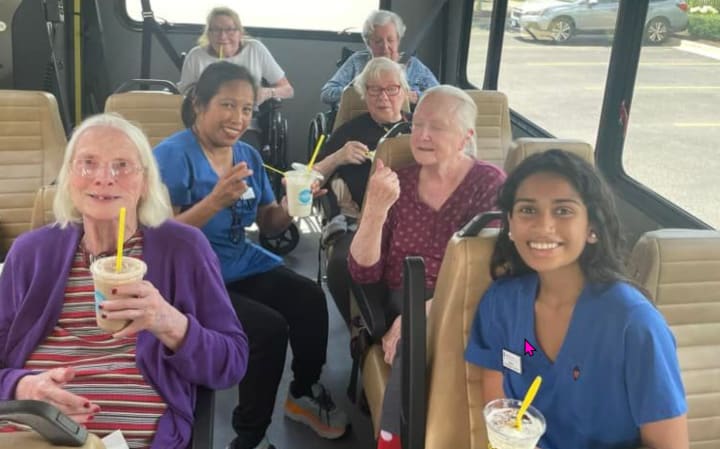
There’s nothing like an ice cream run to wrap up a hot summer day for residents of Emerald Place Memory Care in Glenview, Illinois.
The longer days and slower pace of summer brings many benefits to Individuals living with dementia. They can spend more time outdoors relaxing and enjoying intergenerational activities with family and friends.
If you are caring for a loved one with dementia, make an effort to include them whenever possible in your summer festivities. They’ll feel more engaged with those who are most important to them. And you may find that by fostering these connections, you are bringing benefits to other family members as well, enriching the experience for everyone.
(Summer means baseball and our residents love getting out to a ball game. Our header image shows residents of Willowbrook Place Memory Care cheering on their local Littleton, Colorado Little League players.)
For most families summer means enjoying longer days, vacations, outings, and meeting up with family and friends. It is the time of year when more time is spent outdoors taking in the sunshine and fresh air while engaging in a variety of activities.
Everyone welcomes the warmer, more laid-back days of summer, and that includes individuals living with dementia. Not only is being outdoors more enjoyable, it brings very real health benefits. Dementia Adventure notes several, including these:
Physical benefits:
Emotional benefits:
Social wellbeing:
These are great benefits. However, families may be concerned that, while engaging in family outdoor outings, mom or dad may have a fall, get sunstroke, or wander off from a picnic in the park. Because of this, the decision is often made to exclude them from summer get togethers.
While this is certainly understandable, doesn’t have to be that way. With a little planning and preparation, as well as support from family members and friends, your loved one can not only participate, but enjoy these summer activities.
Here are some tips to help make it easier to include mom or dad in more of your summer activities.
Enhance personal comfort:
Make adjustments to activities to maximize safety and minimize anxiety:
Even with the above precautions in place, there may be instances in which the best option for your loved one with dementia is to not participate. In these cases, you may want to consider in-home care or respite care in a local assisted living or memory care community. Our Anthem Memory Care communities offer respite care.
Summer is a special time of year and a great time to enjoy more outdoor activities. Plan ahead, however, and always make sure you are acting with your loved one’s best interests in mind. Taking precautions for their health and safety will make every activity more enjoyable for them, your family, and you.
For many families embarking on their summer vacations, including their loved one with dementia may not be feasible. The vacation may involve a hectic schedule or a location that is not conducive to caring properly for them. In these cases, a wiser move may be to arrange for your loved one to remain at home.
For some, this will be a welcome decision as they may prefer to avoid the stress of travel. Others, however, may feel left out. That is why discussing your upcoming trip with your loved one should be done in advance and in a way that is sensitive to their needs as well as their emotional wellbeing. Explain to them the nature of the trip and why you feel they will be more relaxed and happier staying at home. Consider setting a date for a visit when you return. That will give them something to look forward to.
Here are some tips to make your time away easier and more secure for your loved one:
Vacations should be a time for fun and relaxation, especially for family caregivers who need time away to unwind and recharge. Following these tips will help ensure that your loved one is safe and secure in your absence. That extra peace of mind will go a long way towards making your vacation enjoyable, knowing you will return to a loved one who has been well cared for.
Post Traumatic Stress Disorder, or “PTSD” as most of us know it, is a condition occurring when an individual experiences a severe reaction after experiencing extreme trauma. PTSD can last months or even years, often triggered by a situation that brings back the memory.
While PTSD can occur in anyone who has experienced a high level of trauma, it is often found in men and women who have served in the armed forces. In the past it was often referred to as “shell shock” and, unfortunately, regarded as more of a weakness than a disorder. In the 1980’s however, PTSD was finally taken out of the shadows and recognized by the American Psychiatric Association as meriting the same level of research and attention as other disorders. Today, PTSD impacts over 13 million Americans.
Veterans with PTSD have almost double the risk of developing dementia.
Increased research into PTSD over recent years has uncovered other significant findings. One is a link between PTSD and the development of dementia.
According to the National Center for PTSD, 7% of veterans have PTSD. The Alzheimer’s Association cites studies conducted with these veterans, which found that their risk of developing dementia is almost double those without PTSD.
These studies note that, while there is no single contributing factor, the added stress hormones being released due to PTSD episodes may play a role in reduced cognition. This can lead to depression and isolation which can make an individual more vulnerable to developing dementia, in particular frontotemporal dementia.
For many veterans, traumatic brain injury (TBI) also brings increased risk.
Frontotemporal dementia affects the frontal and/or temporal lobes of the brain and is often developed due to blunt force trauma to the head. This is referred to diagnostically as traumatic brain injury or TBI, and it is something more likely to occur in combat.
While TBI can range from mild to severe, the experience can increase a veteran’s likelihood of developing frontotemporal dementia as well as Alzheimer’s disease and other dementias. If that TBI is severe, the risk is increased.
How should veterans and their families address these challenges?
Along with greater awareness of the links between PTSD, TBI and dementia come better resources for families of veterans who are experiencing symptoms. The Alzheimer’s Association has some tips which we’ve summarized below:
For veterans:
Get checked for both PTSD and dementia as soon as possible. Early diagnosis brings many benefits including:
For families:
First, know the warning signs of dementia. For veterans who have experienced PTSD, there may be several behavioral changes as well, which may include:
It is important to note that not all veterans with PTSD who are developing dementia will exhibit these behaviors. However, anything outside their normal behavior patterns should be noted and addressed.
The Alzheimer’s Association has more resources with coping strategies and recommendations which families can access here.
Many of the residents at our Anthem Memory Care communities are veterans and we understand their special challenges and needs. Feel free to reach out to us with your questions and concerns. We will be happy to provide you with information and resources to help you and your family.
Related Articles:
Morningside Place Memory Care residents enjoyed a spontaneous visit with the "Lemon Dudes", Colin, age 17, and Lucas, age 13, to sip some delicious lemonade and engage in conversation.
“It was a terrific way to enjoy the weather and mingle with our neighbors,” Sara Coss, life engagement director for Morningside Place, says. “The residents enjoyed supporting the youth in their business venture and connecting by sharing memories of their past.”
The event was covered in the local Overland Park Patch. You can read the full story here: https://patch.com/kansas/overland-park/memory-care-residents-cool-neighborhood-lemon-dudes-nodx.
Hazel Linne celebrated her 102nd birthday in style at Harvester Place Memory Care, surrounded by family and friends.
A former beautician and interior designer, Hazel attributes her longevity to working on the family farm and rising cows and chickens. Her advice to the younger generation: “Be sure to stay active, keep in shape and get plenty of sunlight."
The occasion was covered by the Daily Herald and you can read the full article here.
June 20th is not only the first day of summer, but also the longest day of sunlight this year. That is why the Alzheimer’s Association has chosen it for The Longest Day, their annual drive to get people involved in the fight to end Alzheimer’s disease and other dementias. We can all appreciate the symbolism of having a bit more sunlight to squeeze in more work for such an important cause.
For many family caregivers, every day is the longest day.
The Longest Day spreads awareness not only of Alzheimer’s but advocates for the support of everyone whose life has been touched by dementia. This includes the unspoken heroes behind every individual struggling with dementia, the family caregivers.
For those caring for loved ones with dementia, every day is the longest day. And, because they do their work out of love, they often overlook their own health and well-being. Honoring and supporting caregivers is a big part of The Longest Day. It is also why our Anthem Memory Care communities are hosting a variety of fundraising activities to help put a spotlight on the disease and all of the people whose lives it affects.
For caregivers, having resources is essential to gaining the support they need and deserve.
The first step for family caregivers is to learn more about the disease and tools to help them meet the many challenges that lie ahead. That is why many of the resources provided by the Alzheimer’s Association are geared towards supporting caregivers. Their ALZConnected website is one such resource.
Some of the links from this site include articles, tips and addition resources in the following categories:
There is also a free 24/7 Helpline (800-272-3900) which is staffed by experts in the field of dementia.
And there are other useful resources for those who are caring for someone with dementia.
The Alzheimer’s Association and AARP have teamed up to create the Community Resource Finder, which contains a large database of dementia and age-related resources to help families find local services and programs.
Dr. Tam Cummings, gerontologist, dementia expert, author, and speaker has written numerous articles and books on topics related to dementia. Dr. Tam’s educational videos and can be viewed on our Anthem Memory Care Resources page.
Finally, you are welcome to contact any of our Anthem Memory Care communities for more information and resources and learn more about our own sponsored walks and fundraisers and how you can get involved for next year’s Longest Day activities.
Whether it is a wedding, anniversary, graduation or other milestone, having family together to celebrate is an important part of marking the event and creating special memories. It is a wonderful opportunity for older family members to engage with their younger relatives, tell stories, take photos, and share special memories between them.
That’s why is natural to want to include all your loved ones, even an aging mom or dad who is living with dementia. It is also natural to have a variety of concerns. How will they handle being taken out of their daily routine? Will the excitement be too much for them? Will they become confused or agitated?
While you can’t control exactly how your loved one will handle the event, you can prepare them as well as others in advance.
Start by being an advocate for your loved one. Know their limits.
It is important to consider your loved one’s physical and cognitive health above all else. Those in the early stages of dementia may be much more able to handle the ambient noise, foot traffic, and other conditions typical in a big family event. For others who are deeper into the illness, it can be overwhelming and stressful.
Knowing their limits is important. Be an advocate. If they are clearly not ready to handle a family event, you will want to make other arrangements for them.
If, however, after careful consideration, and you feel they are up for participation, here are eight tips to to help minimize issues and make the experience more enjoyable.
Prepare in advance:
As the event gets closer:
Taking a loved one with dementia to a family event will never be 100% stress free. If you are caring for a mom or dad with dementia, you know that taking them out of their daily routine may create issues. However, by preparing everyone in advance, checking in with your loved one, and having options, will help minimize those potential issues and optimize enjoyment for everyone, including yourself!
Have more questions? Always feel free to contact one of our Anthem Memory Care communities. We’d be happy to answer your questions and provide any additional resources you may need.
Related Articles:
June is Men’s Health Month. Did you know that studies show that men are more likely to ignore health issues than women? It’s time for families to pay more attention to the overall health of their male members, especially those who are older. And overall health includes the risk of developing dementia.
While it is true that two thirds of all Americans living with Alzheimer’s disease are women, that doesn’t necessarily mean men are less vulnerable. For instance, some studies of older men cited by the National Institutes of Health have found that as the testosterone levels decrease, the incidents of cognitive impairment and dementia increase. This includes Alzheimer’s disease. Clearly more research is needed to better understand the role gender plays in the development of dementias, such as Alzheimer’s, but awareness is important for all of us.
The good news is that there are actions men (and women) can take to help them improve their overall health as well as reduce the risk of developing Alzheimer’s. Here are a few:
Men’s Health also has some good tips which we’ve summarized below:
Men’s Health Month is a good time for men, young and old, to start getting more in tune with their body and brain health. If something seems off, have a doctor check it out. Establishing healthy routines and paying more attention to caring for both physical and mental health is important, not just for the men in our lives, but for all of us.
Family members can be of great help to aging parents by checking in with them frequently and making sure they are keeping appointments and taking care of themselves. It can make a big difference in their quality of life now and in the years to come.
We invite you to visit our Anthem Memory Care resources page for more information and links to organizations, articles and other useful resources.
Related Articles:
Whether we’re visiting a park, planting in our gardens, taking a walk or just sitting on the sunny patio, outdoor activities are back in season at our Anthem communities and residents are loving it.
Outdoor activities connect individuals living with dementia to the natural world around them, providing an abundance of physical and emotional benefits. Here are just a few:
There are many more benefits enjoyed by our residents as they some of the following outdoor activities:
Outdoor concerts. As the weather warms our concerts move outdoors! Residents, staff and families enjoy the sounds of the different bands and groups featuring local musicians. Many play old favorites which have been known to spark the occasional impromptu dance party.
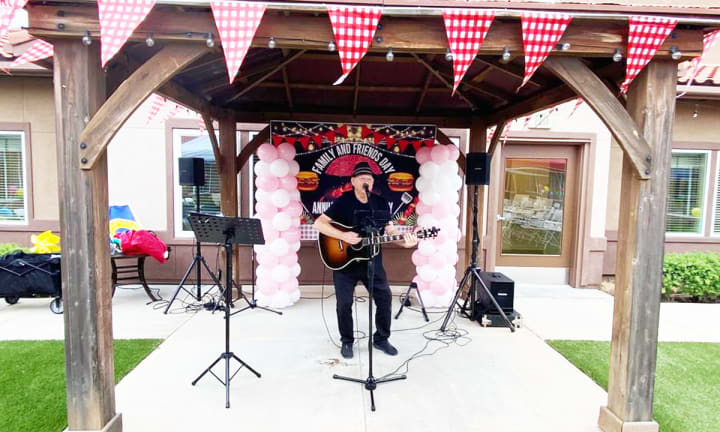
Local musician plays favorite tunes on Family and Friends Day at Vineyard Place Memory Care in Murrieta, California.
Nature field trips. Our residents love visits to the local nature centers and parks. Learning about local wildlife and seeing flowers in bloom is a delight to the senses and helps connect them with nature.
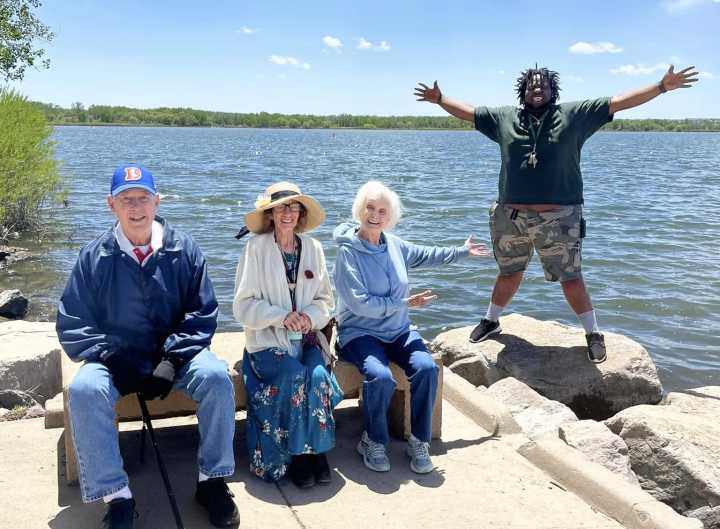
Chelsea Place Memory Care residents and staff enjoy a day at local Cherry Creek Park in Aurora, Colorado.
Planting. This is more than simply pushing seeds into dirt. Our residents participate in trips to local nurseries where they help select flowers and vegetable plants to fill the many planters on the grounds of our communities. They water and weed the beds to keep the plants healthy.
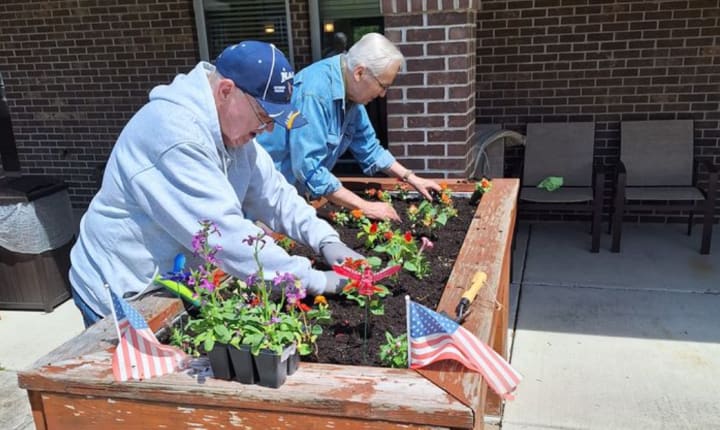
Residents of Harvester Place Memory Care in Burr Ridge, Illinois enjoy filling up the planter with a variety of blooms.
Harvesting, cooking, and eating. Residents also help harvest their vegetable crops. Cooking classes introduce residents to new, delicious recipes. It all comes full circle with a fresh cooked meal for the ultimate “farm to table” dining experience!
Outdoor decorating. Residents take pride in helping to make the patios and other outdoor areas appealing in special ways. Whether it takes the form of building bird houses or crafting hand painted stones to scatter among the plants and flowers, residents enjoy the fruits of their labor every time they step outside.

Residents of Emerald Place Memory Care in Glenview, Illinois join family members to create an assortment of colorful hand painted stones for their garden.
If you are caring for a loved one with dementia, try to make an effort to get them outdoors more often. Whether you take a short walk, visit the local park, or simply sit out in the backyard or garden, the change in environment is therapeutic and can make a big difference in both physical and emotional well-being. That goes for your well-being too!
Remember too that we have resources available to you on our Anthem website. You will find seminars, books, articles, and links to more information on a wide range of topics. We are here to help!
(Our header image shows a resident of Vineyard Place Memory Care on a field trip to a local vineyard. Beautiful surroundings and lots of sunshine!)
Family caregivers often tell us that while all those around them are calling them “heroes” they feel like anything but heroes. They often express feelings of guilt that they are not able to cope with the pressures of caregiving. They may feel guilty about the anger they feel towards their loved one. They may also feel guilty about a decision to transition a loved one into a care environment. This leaves them feeling inadequate in their roles, no matter how much praise is heaped upon them.
First, it is important to know that caregiver guilt and the stress surrounding it is normal. Part of being human is to second guess our own actions, feelings, and motives for everything we do. And ironically, we are far more likely to let someone else off the hook than ourselves.
Just because caregiver guilt and stress is normal doesn’t mean you need to put up with it. Here are some things you can do to help manage caregiver guilt and the stress that comes along with it:
Caregivers play a very special role in the wellbeing of a family member with dementia. It is a difficult role, however, and a journey that is hard for anyone to understand who has not been a caregiver themself. If you are a family caregiver stressed out by feelings of guilt, now is the time to stop, take a deep breath, and begin to take care of yourself.
We invite you to reach out to any of our Anthem Memory Care communities for information, insights, resources, and reassurance. We are always here for you!
Residents of Vineyard Place Memory Care joined with local students from Cole Elementary School to craft special Mother's Day cards. They got creative, adding decorative elements that resulted in a beautiiful collection of cards! Both residents and students enjoy these inter-generational activities. Strong connections and friendships are formed, making these get togethers special and meaningful.
The card making event was covered by the local Murrieta Patch. You can read the full article here.
Morningside Place Memory Care's "Senior Prom" was a huge success! Residents, families, and local friends in the community came together to dance the night away and reminisce about their own proms from years past.
The event was covered by KSHB News. You can watch the video here.
If you are caring for a loved one with dementia, such as Alzheimer’s disease, first know that you are far from alone in your journey. According to the CDC (Centers for Disease Control) every year over 16 million Americans spend more than 17 billion hours caring for a family member or friend with dementia.
The demands of caregiving can, however, cause an individual to neglect their own health. While putting others first is certainly an admirable trait, it opens the door to an increased risk of anxiety, depression, guilt, isolation, and other issues.
It doesn’t have to be that way. Because, as challenging as caregiving is, you should know that there are many resources available to help you navigate more successfully through the emotional twists and turns associated with caring for your loved one with dementia.
First, let’s look at some of the warning signs that your mental health might be in jeopardy.
Any one of the above factors can contribute to caregiver “burnout”, a form of depression. If it goes untreated, it can lead to serious health issues for you and compromise the quality of care you provide for your loved one.
The good news is that there is help available if you know how and where to find it.
Start by scheduling an appointment with your doctor. Your doctor can help you by providing referrals and recommendations to get you on the road to feeling better both physically and emotionally. This is an important first step to taking control of your own health. It is something you wouldn’t hesitate to do for a loved one.
Now it is time to make your own health a priority!
The Alzheimer’s Association has published a comprehensive list from the American Psychiatric Association of steps caregivers can take to get back control over their mental wellbeing. Here are five of their key tips:
While you are taking the above steps, we also recommend that you explore some of the many online resources. There is an abundance of blogs, articles, webinars, and other online resources available to help you increase your knowledge and self-awareness as a caregiver. Here are a few to check out:
https://www.alz.org/help-support/resources
https://www.nia.nih.gov/health/alzheimers-caregiving
https://www.caregiver.org/resource/caregivers-guide-understanding-dementia-behaviors
https://alzfdn.org/caregiving-resources/
The journey of a family caregiver is a challenging one. And it is not one to be taken alone. Reaching out to family and friends and establishing professional support is essential. It will help you to regain control over your daily life while improving your mental health and wellbeing.
You can feel joy again by making your own mental health a priority. Start today!
Residents and staff of Willowbrook Place Memory Care love to give back!
They recently hosted a special "Burritos for Heroes" lunch for local firefighters to show support for their dedication to serving the community.
The event was covered by local KUSA NBC 9 in Denver. You can watch the full coverage here: https://www.9news.com/video/features/good-news-memory-care-facility-hosts-get-together-to-thank-firefighters/73-dacc73b6-85e4-4cc8-baa8-1d1756627e61