
The medical world relies upon clinical trials to test new potential breakthroughs in medications and therapies by assessing their efficacy in humans. We all hear about them, but understanding how they work and who they benefit is another matter altogether. Most have more questions than answers.
What are the different kinds of clinical trials for Alzheimer’s? Should you or a loved one consider participating in one?
At any given moment, thousands of clinical trials are being conducted worldwide.
The nature of clinical trials varies greatly depending upon the drug or other treatment, the medical condition being tracked, and the demographics of the population being evaluated.
Today, according to ClinicalTrials.gov, there are hundreds of thousands of clinical trials being conducted all over the world. Over 180 U.S. trials involve new drugs and therapies to treat Alzheimer’s disease are being conducted.
What are these trials and what do they accomplish?
The Alzheimer’s Association breaks down clinical trials associated with treatments for Alzheimer’s disease as follows:
How does the process work?
While the process will vary somewhat depending on the type of trial, the structure basically comes together as follows:
It is important to note that an early diagnosis of Alzheimer’s will open up more clinical trial opportunities. And it is just one of the reasons why early testing is so important. There are many other benefits that can improve overall health, medication efficacy, and other therapies to maintain cognitive health for as long as possible.
Should you or a loved one participate in a clinical trial?
Only you can answer that question. But it will be easier to do so after you have armed yourself with as much information as possible about clinical trials. Discuss the pros and cons with your family. Should you decide to move forward, the Alzheimer’s Association has a website that will help you find trials in your area.
Regardless of your decision, keep your own research activity up to date. Attend seminars. Collaborate with your healthcare provider. Being informed and staying on top of the latest potential breakthroughs is a great way to optimize your choices and tackle the many challenges that lie ahead.
At the heart of purposeful living is helping others. Nothing is more emotionally rewarding than giving back. It can take many forms, from supporting local charities, to volunteering, to donating goods to local homeless shelters, and other activities that lift up those around us and help make their lives better.
At our Anthem Memory Care communities, our residents are involved in a variety of projects that allow them to connect to and engage with their local communities. Many of them were civically active in their earlier years and appreciate the opportunity to continue to give back to others. And, when it involves using their abilities and talents, better yet!
Studies support the benefit of sense of purpose for individuals experiencing cognitive loss.
You may have heard of Chicago’s Rush University study that showed the having a positive sense of purpose helped reduce cognitive decline by 50%.
Another study conducted by Johns Hopkins found that MRIs conducted on elderly individuals who were participating in tutoring programs for children had stronger cognition. The area of their brains known as the hippocampus showed less atrophy.
While civic engagement has not shown to reverse dementia, it may help to bolster cognitive function, which could in turn help slow the progression of the disease.
This is one of the reasons our Anthem Memory Care communities ensure that there are plenty of opportunities for our residents to use their skills and talents to bring joy into the lives of those around them. Here are a few examples of our special projects and “random acts of kindness”:
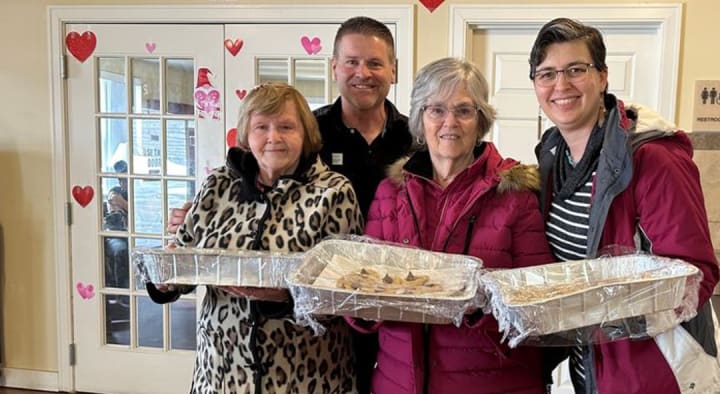
Residents and staff of Morningside Place Memory Care in Overland Park, Kansas decided to bake cookies and hand-deliver them to the assisted living community next door! It was part of their Random Acts of Kindness Week project.
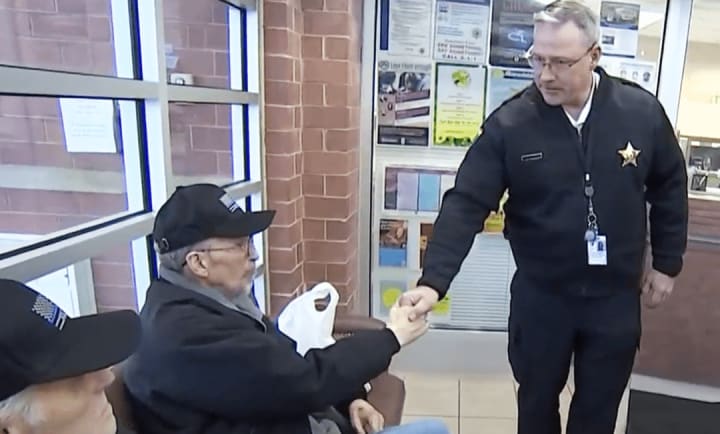
Former police officers from Porter Place Memory Care in Tinley Park, Illinois took a batch of homemade cookies to the local station to swap stories and thank first responders for keeping the community safe.
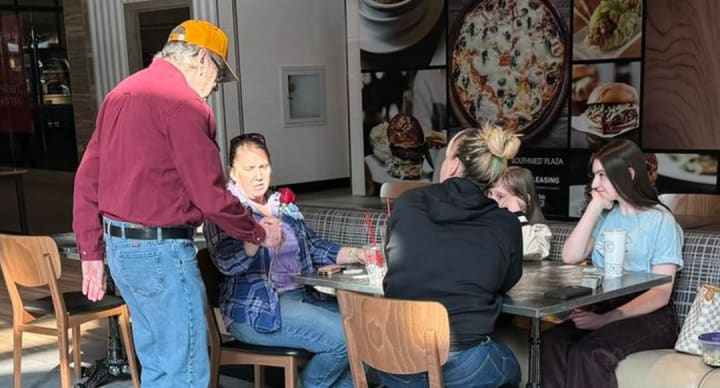
For their Random Acts of Kindness Week project, residents of Willowbrook Place Memory Care in Littleton, Colorado handed out roses in a local mall to surprised shoppers!
If you are caring for a loved one living with dementia, look for opportunities to bring meaning into their lives. Ask them how they’d like to help and encourage them to put their abilities to work for others. It can be in the form of small acts of kindness; helping to get canned goods together for a local charity drive or going through old clothing and finding items to donate to local shelters.
It is important to always remember that leading a purposeful life and giving back isn’t only for some people. It’s for everyone.
(Our header image shows a canine recipient of goodwill as of residents of Willowbrook Place Memory Care in Littleton, Colorado donated blankets to Pepper’s Senior Dog Sanctuary. Seniors helping other seniors! The event was covered by local TV station KDVR, Channel 2.)
Residents of Chelsea Place Memory Care were treated to a special Sweetheart Spa Day by local Regis Jesuit High School students. These students are regular visitors to Chelsea Place and the inter-generational interactions bring joy and purpose to both the students and the residents.
The event was covered by local Channel KDVR FOX 31. You can watch it here:
Did you know that 80% of older adults acknowledge the benefits of early testing for dementia? This is according to the findings of a University of Michigan National Poll on Healthy Aging of individuals aged 65 to 80.
And yet many individuals continue to ignore early warning signs of dementia. Often this is due to a fear of receiving a diagnosis of Alzheimer’s. And yet, when caught early, there are many benefits to be had, benefits that become more elusive as the disease progresses.
The Alzheimer’s Association has identified five good reasons why it’s so important to get tested early. They are as follows:
It’s actually easier than you may think to get tested. And the good news is that testing is covered by Medicare. It supports cognitive assessment services to individuals who are showing signs of cognitive impairment, along with a shorter test for those who aren’t yet experiencing any cognitive challenges.
Why wait? If you or a loved one is over age 65, even if there is no evidence of memory loss, it is prudent to be tested. Knowledge is power after all. And early diagnosis will open doors to clinical trials, treatments, and planning at a time when you have more control over your life. Early testing is a gift to you and to the family you love.
Residents of Liberty Place Memory Care in West Chester, Ohio have decorated over 100 coffee cup sleeves each with a special Valentine message. The residents will be at Biggby Coffee on February 13th to personally hand them out to customers. What a great pre-Valentine's Day gift for coffee lovers!
An article in Senior Living News has the details: https://www.seniorlivingnews.com/anthem-memory-care-residents-to-spread-smiles-to-unsuspecting-coffee-lovers-for-valentines-day/
For family caregivers of loved ones with dementia, the day-to-day interactions and dealing with both physical and behavioral issues is something you have had time to adjust to. While your journey has not been an easy one, you are learning to read verbal and nonverbal cues and, generally by trial and error, knowing what to say and what not to say.
However, visiting friends and family members who are not in regular contact may find interacting with your loved one daunting. If they are not properly prepared, what was once a simple visit can be unsettling and even traumatic for more sensitive individuals. Sadly, the solution for many family caregivers is to drastically limit or completely avoid these visits altogether. Yet that deprives everyone of what could be a meaningful experience, especially for the family member with dementia.
It doesn’t have to be that way! With some planning and preparation, that visit can be less stressful and more enjoyable for everyone.
Here are some tips to prepare your family in advance.
Once you have laid the groundwork, here are five tips for family and friends:
By planning and putting these tips into play, you can help pave the way to a smoother, more enjoyable visit. And, one good visit will encourage more visits and social interactions which are so important to the well-being of your loved one and to your family.
Need more tips? Feel free to reach out to any of our Anthem Memory Care communities. We recognize the importance of family interactions to individuals with dementia. We’ll be happy to answer your questions and provide more insights to help make these visits easier.
You can do this! And we’re here to help.
Related Articles:
Residents of Willowbrook Place were on a mission to help other seniors... senior dogs, that is! Residents and staff visited Pepper's Senior Dog Sanctuary bringing homemade blankets and lots of love. Many residents were once dog owners and enjoyed interacting with their canine contemporaries.
The event was covered by local TV station, Fox 31/Channel 2. You can watch the video here:
https://kdvr.com/video/memory-care-residents-gift-senior-dogs-with-blankets/9364362
Most older Americans want to be tested for dementia. They recognize the benefits of early detection. Furthermore, they look to their physicians to make them aware of these tests and to advise them as to when and how to take them.
The problem is that 80% of older Americans have yet to take a cognition test.
These troubling findings are the result of the University of Michigan National Poll on Healthy Aging, published in a 2023 report and presented at the Alzheimer’s Association International Conference in Amsterdam.
Other studies support these findings as well. One, conducted by the Government Accountability Office (GAO) and cited by Senior Housing News reported that only 2.4% of Medicare beneficiaries diagnosed with Alzheimer’s disease had received their initial assessment through Medicare.
That is because many Americans with Medicare coverage don’t realize that it includes cognitive assessment services to individuals who are showing signs of cognitive impairment. It even covers a shorter test for those who aren’t yet experiencing any cognitive challenges.
Why the disconnect?
As it turns out, it is more complicated than one might think. Here is where much of that disconnect lies:
For healthcare professionals:
For Medicare beneficiaries:
It is time to increase awareness, education, and accessibility to testing.
But is this happening? To a degree it is, but more work is needed to make a meaningful difference. The Department of Health and Human Services (HHS), along with the Centers for Medicare and Medicaid Services (CMS) are engaged in outreach programs targeting providers as well as eligible Medicare recipients.
Our Anthem Memory Care communities are active in the industry working to educate and bring greater awareness Medicare beneficiaries of their eligibility for dementia testing.
Dr. Tam Cummings encourages aging Americans to take advantage of available testing.
Dr. Cummings, dementia expert, gerontologist, and author, is an advocate for early detection of Alzheimer’s disease and other forms of dementia. She urges individuals to be more proactive and assertive with their physicians and take a more active role in managing their cognitive health. Dr. Tam has a series of tools that identify key behaviors that are known to be indicators of dementia.
There are many benefits to getting tested. Here are just a few:
At Anthem Memory Care, we urge families with aging loved ones to encourage them to be tested. The earlier an individual with Alzheimer’s is diagnosed the more time they will have to plan for the future and develop a strategy to help them live their best lives going forward.
Person-centered care is a concept we are hearing about more often these days. And as far as we’re concerned, that is as it should be. It has been the focus of our Anthem Memory Care communities since we opened our doors and continues to impact everything we do, from day-to-day care, to dining, to the many activities and programs our people provide for our residents.
An integral part of person-centered care is recognizing the need for residents to spend their time in purposeful activities. After all, regardless of who we are and what we do, we all want to have a sense of purpose in our daily lives. That sense of purpose can make a big difference to people living with dementia.
Pathways of Purpose is about more than just living, it’s about living well, despite dementia.
The traditional care model in this industry has always been more task oriented than engagement oriented. However, when staff members look at each interaction with residents as a series of tasks it hinders meaningful connections with them. It also stifles the natural desire to find meaning in everything they do. This isn’t healthy for the resident or for the caregiver.
The recognition of the importance of purpose in every life is the driving force behind our Pathways of Purpose, a person-centered approach to life engagement that is tailored to the ability of each resident to live his or her best life. The program supports resident wellbeing by affirming identity, fostering meaningful connections with others, supporting autonomy, and providing opportunities to keep growing. The goal is to go beyond simply caring for individuals with dementia, it is about living well, despite having dementia.
Every activity is an opportunity to find purpose. That’s where our life engagement team excels.
Central to Pathways of Purpose is our life engagement team. They are creative, dedicated individuals whose unique talents and creativity bring purpose to every activity and project they design. Whether it takes the form of a visit with local students, a fund-raiser, or putting their skills to work to build and create things to give to those in need. These activities are fundamental to leading a purposeful life. We depend on our life engagement team to bring them to life. And they never disappoint.
The impact of this new approach has led to marked improvements in emotional wellbeing.
Since Pathways of Purpose has been implemented, we have noticed behavioral changes in both residents and staff. Residents are less inclined to become agitated and there have been fewer instances of wandering. Staff members report that their jobs seem easier and more enjoyable when they approach each interaction differently.
Michael Zywicki, Anthem’s VP of Programs and Engagement recently was interviewed by McKnight’s Senior Living about person-centered care and the Pathways of Purpose ideology. He explained that “living the program as a culture” is key to making staff members feel connected to residents and to each other. Getting to know residents in smaller settings has increased the sense of intimacy and has actually led to the need for less medication use for behavioral issues.
“If you can get a smile out of somebody, you’re doing something right.”
Michael sums it up, explaining that Pathways of Purpose is more than just another program. It impacts culture because staff has a new outlook on how they impact the lives of residents. “We’re trying to look at just how we do everything differently now,” he told McKnight’s Senior Living. “One slogan is, ‘If you can get a smile out of somebody, you’re doing something right’.”
(Our header image shows Christopher Balmes, Life Engagement Director for Vineyard Place Memory Care in Murrieta, California sharing a spontaneous moment of fun with residents.)
In celebration of National Law Enforcement Day, three former police officers from Porter Place Memory Care paid a visit to their local police station in Chicago. George Berryman, Tom Manion, and Curtis Cowsen dropped in to share memories and a batch of fresh baked cookies. The visit was heartwarming for the officers who enjoyed hearing stories from the retired police veterans. Even though they are living with dementia, they still remember the service they once provided to their own communities.
The visit was covered by local NBC TV station Channel 5. You can watch the full video here:
While the holidays are a time to enjoy special moments with family and friends, we hear from many adult children who, instead of returning with fond memories, return filled with worry about cognitive and behavioral changes they’ve observed in a parent.
Those changes may include one or more of the following:
Is it just normal aging or early stages of dementia?
That, of course, is the question on so many family members’ minds. And it is a question that is not easily answered without doing some of your own groundwork and, of course, having a consultation with your loved one and his or her health provider.
The first step is to take a deep breath and begin to organize your thoughts and your actions.
The good news is that there are available tools to help clarify your observations.
One set of tools is available from Anthem Memory Care, courtesy of Roobrik. Here are a few of the tools. Each will ask you some questions about your observations and provide insights to help you decide next steps. Note that these are not diagnostic tools but can provide information that can help clarify your thoughts and serve as a reference when meeting with healthcare professionals.
Another useful tool is the Dementia Behavioral Assessment (DBAT) checklist, which you can access here.
Also be sure to check out our Resources page for more insights and information.
This is a challenging journey. But one you needn’t take alone.
As you begin to take steps to understand the changes you are witnessing in your aging parent, it is important to include in that process those who are close to you. Family members and trusted friends can provide additional insights to help keep you focused and as objective as possible.
It is also important to know that you can reach out to any of our Anthem Memory Care communities with your concerns. So many members of the Anthem team have experienced dementia within their own families. We are here to answer questions, provide a sympathetic ear, and provide useful resources to help you meet the challenges ahead.
Related Articles:
Most people have, at one time or another, experienced serious mental and emotional distress. Often it is short lived, and they are able to navigate through each dark period. Yet, for others, preserving good mental health is something that must be worked at constantly. And it isn’t always easy.
For individuals living with dementias, such as Alzheimer’s, mental health issues, such as depression, can be especially challenging because they are being experienced in addition to the cognitive and behavioral changes associated with the disease itself.
First, it’s important to understand that Alzheimer’s is not a form of mental illness.
As Dr. Tam Cummings, noted author and dementia expert notes, Alzheimer’s is a brain disease. An article from North Georgia Clinical Research points to a few differences between mental illness and Alzheimer’s.
And, yet there may be a link between mental health issues and Alzheimer’s.
A study from Harvard Medical School points to a connection between depression in older individuals and impaired cognition. It found that a state of depression, along with the presence of brain amyloid (a marker for Alzheimer’s) can lead to memory loss. There is hope that clinical trials targeting older individuals with depression who have medical markers for Alzheimer’s can lead to earlier identification and intervention to slow the progression of the disease.
How can individuals living with Alzheimer’s optimize mental health?
Here are a few ideas:
Individuals with Alzheimer’s, like all of us, will have good and bad days that impact their mental health and well-being. If you are caring for a loved one with Alzheimer’s it is important to arm yourself with information as well as develop your own support system. Mental health is critical to all of us, and that includes caregivers.
Feel free to reach out to any of our Anthem Memory Care communities. We will be happy to answer your questions and provide resources to help you on your journey.
Related Articles:
Every year around this time residents and staff at our communities are busy taking stock of the year that is ending and making new lists of resolutions for the new year.
Many of the resolutions are simple, such as “smiling more often”, or “appreciating the small things in life.” What is most important, however, is not the goal itself, but the satisfaction of setting it and taking steps to achieve it.
Setting goals is good for everyone, regardless of age or health conditions.
A UCLA study found that when personal goals were set by a group of individuals with dementia as well as caregivers, about three-quarters of them met or exceeded their goals within a twelve month period. Most of the goals were non-medical in nature, including such things as “getting financial affairs in order” or “participating in activities outside the home.”
Now is the time to set some goals for the new year.
Here are a few tips from the Institute on Aging to help family caregivers support goal setting for a loved one with dementia.
Whatever the goal might be, it is so important to be supportive. Encourage your loved one every step of the way. Recognize that there will be good days and challenging days when concentration levels may be lower. Be ready to take a break and start up again the next day. And, while you’re at it, add in a few goals for yourself as well!
Wishing you and your family a wonderful New Year!
Related Articles:
The program "Operation Christmas Child" organized each year by Samaritan's Purse is one with special meaning to Highline Place Memory Care's Life Engagement Director, Annalise Wasberg. Annalise was herself a recipient of the program years ago as a child of military parents. She told her story recently to McKnight's Senior Living. "No matter where we are in life, it's important to give back in any way we can," she said.
That is so true for residents of Highline Place who enjoy the purposeful activity of filling special red and green shoe boxes full of small toys for children in need.
You can read the full story here:
When you have played Santa Claus for local children for so many years, why stop now? That's the attitude of James Berryman, a Highline Place Memory Care resident who has enjoyed putting on the red suit and listening to children share their Christmas list for years.
James was joined by "Mrs. Claus", wife, Teresa Berryman. Everyone enjoyed the special visit. The event was even covered by the Denver Post!