
Rupert "Bob" Wendall joined with fellow Harvester Place residents, friends and family to celebrate his 100th birthday! A World War II veteran, Bob is a skilled craftsman and machine designer who, in addition to his wife of 25 years, has five children, fourteen grandchildren, and twenty great-grandchildren!
Bob's secret to a long life? "Find someone you can talk with, so you can talk for hours. You'll have a long-lasting relationship and a healthy marriage."
The celebration was featured in the local Burr Ridge Patch. You can read the full story here: https://patch.com/illinois/burrridge/burr-ridge-man-marks-100th-birthday
How time flies! Anthem Memory Care turns fifteen this month. Ours is a story full of ideas, vision, challenges, and great joy.
Founder, Isaac Scott, recalls the emergence of the Anthem concept from his own experience years ago. “I watched my grandmother transition from care facility to care facility and realized there had to be a better way to support loved ones with dementia,” he recalls. “My grandmother and, subsequently, my grandfather ended up living their final years at a home called Cornelia’s House, where they experienced love and joy despite their cognitive decline. We started Anthem to take the magic of that home and provide it on a larger scale.”
Today, Anthem Memory Care consists of nineteen communities and growing. Growth, however, doesn’t diminish the mission of “Protect, Engage, and Love”, which remains central to our guiding principles, never wavering in our commitment to our residents, families, and staff.
We thought a great way to celebrate would be to share with you 15 things that we feel define our communities and our organization.
Did you know that …
We invite you to find an Anthem community near you. Walk in and you’ll feel a sense of connectedness and purpose between all those who live and work inside our doors.
Happy birthday, Anthem Memory Care. We’re proud of our first fifteen years. Here’s to the next fifteen!
The holidays are a wonderful time of year to enjoy gatherings with families and friends. However, they can raise anxieties for elderly loved ones who live alone, especially if they have been diagnosed with dementia. What was once a family home full of noisy celebrations can feel empty and cold for older individuals whose children have long since moved away.
That sense of isolation can cause serious problems. According to the U.S. Surgeon General, isolation and loneliness affects 50% of the population and brings with hit a higher risk of dementia, as well as cardiovascular disease and stroke.
Allison Moser Mays, MD, MAS at Cedars-Sinai Hospital urges families to take isolation seriously. “Loneliness and isolation, part of what we call ‘social determinants of health,’ are established risks for poor health and early death, especially for aging adults. The health risks are equivalent to smoking up to 15 cigarettes a day,” she says.
The holidays can make isolation even more dangerous for elderly individuals. The optimum solution, of course, is to have mom or dad come for a holiday visit. However, for some families that is not possible, whether due to logistics or parents not wanting to leave the comfort of their own homes.
What are some things families can do to reduce isolation by keeping a connection with their elderly parents and friends over the holidays?
The holidays are a time to share special moments with family and friends. While in-person visits will always be optimum, with some planning, creativity, and perseverance, there are ways to keep the connection alive and well and make everyone feel loved and included this holiday season.
Related Articles:
Chelsea Place temporarily went "to the dogs" last week as residents, staff and family members brought in their family dogs for a special “Santa Pup” visit. The treat? Homemade dog biscuits!
The event was covered by local Denver TV station, KMGH. You can watch the video here: https://youtu.be/sVcCG2NQYdA?si=8FXkDK950SIp9OUx
We are proud to announce that Colleen Kamin, Executive Director of Porter Place Memory Care, was selected as one of an elite group of long-term care leaders to receive the McKnight’s Pinnacle Award. Colleen was given the Agent of Change award!
Read more about the award here: https://www.mcknights.com/news/mcknights-announces-2nd-annual-pinnacle-award-winners/
The holidays are a time for giving, whether it comes in the form of presents, toy drives, or spending precious time with family and friends.
Residents of our Anthem Memory Care communities give back all year long through many special projects and fundraisers. The holidays, however, provide a meaningful opportunity to engage with local organizations and shelters in ways that benefit the greater community.
One of the favorites is a program called Operation Christmas Child run by Samaritan’s Purse, a faith-based organization that helps underserved communities all over the world. Operation Christmas Child involves filling special green and red shoe boxes with small toys and other goodies. The boxes are then sent out to organizations worldwide who distribute them to children in need.
Below are a few special photos of our communities in action:
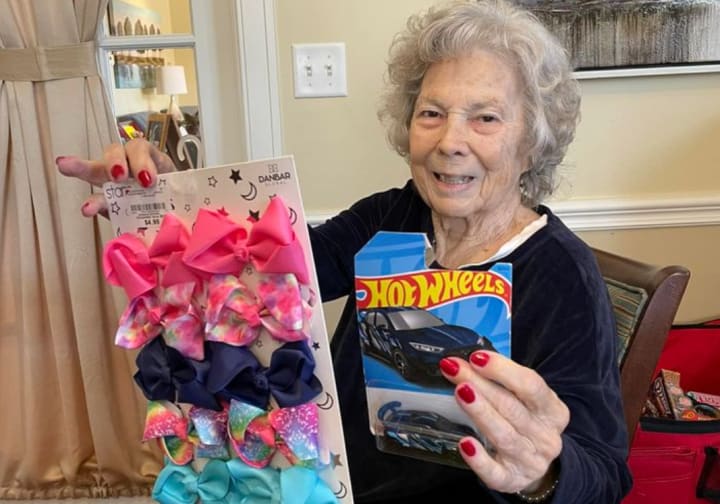
This delighted Chisholm Place Memory Care resident in Wichita, Kansas holds up some fun gifts for Operation Christmas Child.
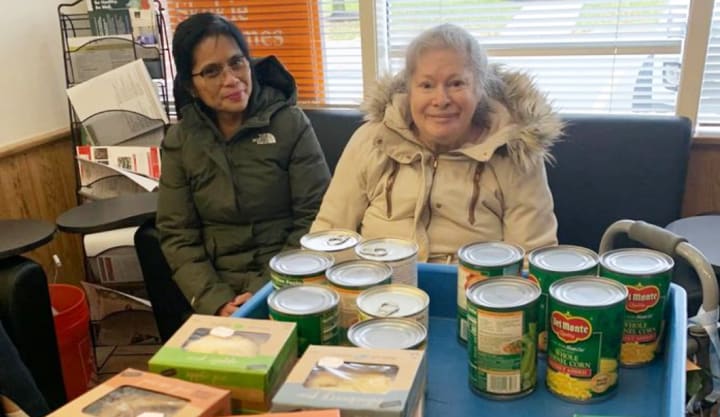
Emerald Place Memory Care residents and staff in Glenview, Illinois held a holiday food drive.
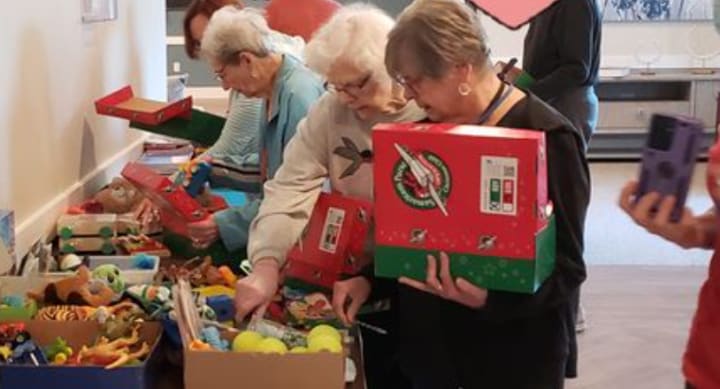
Cascade Creek Memory Care residents in Rochester, Minnesota fill boxes for Operation Christmas Child
These programs do much more than bring cheer and comfort to underserved communities. The act of filling a shoe box, collecting blankets for shelters, or doing a canned food drive brings a very tangible feeling of joy and good will, providing residents of our Anthem communities with the greatest gift of all: purpose.
You may find it interesting to know that there is science to back this up. According to the Cleveland Clinic, charitable acts release what are often called “feel good” hormones that promote a sense of well being. They are:
As psychologist, Susan Alberts, PsyD, remarks, “When we do things for other people, it makes us feel much more engaged and joyful. That’s good for our health and our happiness.”
Many of our residents have been lifelong volunteers and contributors to a range of worthy causes. Why should they stop now? We believe that leading a life with purpose is one of the most important things we can do for our residents. That is why there is always a new project in the works to help them give back to the community.
Tiffany Bell, life engagement director for Cascade Creek Memory Care explained the benefits in a recent interview with KIMT TV. “Sometimes, a diagnosis of dementia might feel like it robs the person of an ability to give back. The truth is we just have to help with the process. Residents come alive when they’re doing something for others, and the feeling they get --- the feeling that we all get when we care for others doesn’t go away just because someone is living with a diagnosis of dementia.”
(Our header image is a wonderful collage of Highline Place Memory Care residents in Littleton, Colorado getting boxes together for Operation Christmas Child!”
A group of residents of Liberty Place Memory Care put their pie baking skills into action with a freshly baked assortment of delicious fruit pies. Their goal? To present the pies to their local Liberty Fire Station #12 and thank these amazing individuals for their service to the community. The visit to the fire station and gifting of pies was covered by the local Cincinnati Patch. You can read the full story here: https://patch.com/ohio/cincinnati/memory-care-residents-deliver-pies-thanks-fire-department-nodx
Residents and staff of Vineyard Place are hosting a blanket drive through the end of the month. They are accepting new and gently used blankets to deliver to local homeless shelters in December. You can read more about their efforts in My Valley News: https://myvalleynews.com/blog/2023/11/26/murrieta-memory-care-community-hosts-blanket-drive/
Thanksgiving is an important holiday because it encourages Americans to take time to gather with friends and family and celebrate all that we have in our lives. In a world where there is plenty to worry about, Thanksgiving is a welcome respite.
For those caring for loved ones with dementia, finding things to be thankful for can be challenging, even on Thanksgiving. The chronic worry and concern for your loved one along with the stress of handling all their needs as well as yours may make those moments of thankfulness feel out of reach.
Moreover, Thanksgiving ushers in the holiday season with its own unique set of challenges. In many instances you find yourself running interference to help buffer all the hustle and bustle of holiday celebrations. It may be hard to relax long enough to grab those precious moments of peace and joy.
Yet there are small steps that can be taken to slowly cultivate an ongoing sense of thankfulness, not just on Thanksgiving, but all year long. Learning to do so can help bolster your peace of mind even during difficult days.
Research bears this out. A study cited in Greater Good Magazine involved 170 family caregivers of individuals with dementia. They were split into two groups. The first group simply reported their day-to-day observances and issues. The other group received a video call each day from a coach who trained them to develop these skills:
The study found that, compared to the second group of caregivers, those caregivers who were coached on positive emotion skills began to experience less depression and more positive emotions. They reported feeling less anxious and began to experience more of the positive aspects of being family caregivers, including feeling appreciated, useful and connected.
Could these steps work for you? The answer is “yes”, but it’s important to realize that nothing happens overnight. As with working to build any new habit, big changes begin with small, consistent steps.
The good news is that you don’t have to take this journey alone. There is an abundance of resources available for family caregivers to help meet special challenges and provide breathing room to keep the spirit of thankfulness alive. Consider contacting one of our Anthem Memory Care communities and learn more about our respite care as well as our dementia support groups. These are lifesavers for caregivers, providing a supportive environment in which to share your thoughts and struggles with others, with assistance from our professional therapists.
While there will be plenty of challenging days ahead, when you dig down deep there is always something to be thankful for. And, when you find that something, it makes all the difference.
Related Articles:
Nine veterans/residents of Harvester Place were honored for their service on Veteran's Day at Harvester Place. The ceremony included receiving a pin and a hearty "thank you" for their service. Family and friends joined in the celebration.
The event was covered by the Daily Herald. You can read the full story here: https://www.dailyherald.com/submitted/20231115/burr-ridge-memory-care-residents-honored-for-patriotism
Nine very special residents were honored for their service at Grace Point Place Memory Care. The Veterans Day ceremony was formal and moving as each veteran came forward to receive a special certificate and handshake as they were thanked for their service. Recipients included William Carnavan, a Marine Corp Reserve who served as a radio and telephone technician. The event was covered by the local Village View.
Residents, staff, and family members at Morningside Place Memory Care joined in a special tribute to its veterans in honor of Veterans Day. It was a special time for everyone as each veteran was honored with a certificate and handshake along with a "thank you" for their service.
As Keith Melick, clinical service director, said, "The vets who live here, they do have memory problems, but you know that they never forget."
The event was covered by local news channel KSHB. You can watch the video here:
Almost everyone knows somebody with diabetes. Diabetes affects over 34 million Americans. The American Diabetes Association reports that 25% of individuals age 60 and older in the U.S. have either diagnosed or un-diagnosed diabetes. Add to that the fact that about half of Americans are in a pre-diabetic state and you can begin to understand the prevalence of the disease.
Diabetes, according to the Cleveland Clinic, Diabetes is a disease involving insulin, the hormone that regulates blood glucose in the body. Type 1 diabetes is an autoimmune attack on the pancreas resulting in a lack of insulin. Type 2 diabetes, the most common form, occurs when the pancreas doesn’t use the insulin it produces efficiently, resulting in persistently high blood sugar levels.
Exploring the link between diabetes and cognition.
Diabetes can also bring with it a higher risk of other serious conditions and diseases. It can cause kidney disease, heart disease, stroke, and other serious issues.
One area that is still being researched is the potential link between diabetes and cognition. The Alzheimer’s Association notes that while we still don’t understand the full dynamics of how diabetes impacts cognition, there is a clear link between high blood sugar and brain health.
Here are six key findings:
What is type 3 diabetes?
While most individuals are familiar with type 1 and 2 diabetes, there is in fact a third type of diabetes. A multi-institution clinical study conducted by the Mayo Clinic revealed that the Alzheimer’s gene, APOE4, appears to interfere with brain cell’s ability to use insulin. This causes those cells to starve and ultimately to die.
This gene that starves brain cells of insulin has created what many researchers refer to as type 3 diabetes, directly associated with Alzheimer’s disease.
Healthy habits can make a difference.
The good news is that there are ways to reduce the likelihood of becoming diabetic and, even for those who are diabetic, can help optimize health. They are as follows:
These are all commonsense tips and yet they can have a powerful impact on overall health. If you are caring for an individual with dementia, making sure they follow these health tips can keep them in the best shape possible for as long as possible.
Diabetes is a silent killer that can creep up on an individual. Once diagnosed, the condition will persist indefinitely. Doing everything possible to optimize your health and that of your loved ones can help avoid developing not only diabetes, but other serious diseases as well.
Healthy habits benefit everyone. And the time to start is now!
Related Articles:
According to research conducted by The Alzheimer’s Association, about 83% of care provided to older Americans comes from family members. Of that amount, almost half are caring for loved ones with dementia. They are not paid and don’t expect it. What they do expect, however, is to provide a level of care that lies well beyond what they can handle as human beings. That’s what makes it so challenging.
Research indicates that greater stress is experienced by those caring for a loved one with dementia than any other condition. According to Elen Fazio, a health scientist administrator at the National Institute on Aging, this is likely due to the challenging nature of Alzheimer’s disease and the need for around the clock care.
That is why supporting family caregivers is so important!
November is National Family Caregivers month. At Anthem Memory Care, we believe that it should extend beyond acknowledging the amazing work done by family caregivers and be used as an opportunity to learn more and take action to support them.
How can you help?
If you know someone caring for a loved one with Alzheimer’s, here are five things the Alzheimer’s Association suggests that you can do to support them:
While National Family Caregivers Month puts a much-needed spotlight on family caregivers, in reality they need our support every day of the year. It starts with all of us doing our part.
Make it a point to check in with the family caregivers in your life. And feel free to contact any of our Anthem Memory Care communities with questions and to learn more about our resources for family caregivers, such as respite care and our dementia support groups.
Related Articles:
November is Alzheimer’s Disease Awareness month, a great time to educate and spread awareness of the disease. There is much work to be done, however, both in terms of research, education, and finding a cure as well as improving our approach to diagnosis and treatment.
Misconceptions about Alzheimer’s continue to persist. Only through a consistent flow of accurate information and insights can we begin to dispel them.
That is why facts matter. Here are just a few from The Alzheimer’s Association:
And here is another fact that cannot be emphasized enough:
Brain cancer is a disease of the brain. So is Alzheimer’s. Yet they are treated very differently.
Tam Cummings, PhD, or “Dr. Tam” as she is called, is an author and licensed expert in dementia, traveling throughout the U.S. conducting seminars and workshops. She also conducts dementia training for caregivers and families. Dr. Tam often draws comparisons between Alzheimer’s and other diseases. For instance, when an individual is diagnosed with brain cancer, it usually is preceded by symptoms that are brought to the attention of their physician, who immediately prescribes a battery of tests. Once the diagnosis is made, the individual is given access to specialists and a treatment plan is begun. Furthermore, they are surrounded by a supportive community.
However, when an individual is diagnosed with a brain disease, such as Alzheimer’s, they are too often met with a veil of confusion and left to sort it out on their own. Yet, as Dr. Tam notes, they deserve the same level of attention and support that comes with other brain diseases.
That veil of misinformation and misconception impacts society as well. Cancer is clearly a disease that the person has no control over. That clarity is too often missing with dementia. This leads to misconceptions, which include blaming the victim, or believing it is a behavioral issue or even a weakness.
Awareness and education is the first step to changing how we deal with Alzheimer’s.
Dr. Tam and other leaders are dedicated to educating everyone, including caregivers, on the facts about dementia and working to change the way we approach the disease and relate to individuals living with it.
Our Anthem Memory Care communities are working with Dr. Tam to keep our own staff up to date and informed as well as partnering with organizations that foster a more integrated approach to the disease.
How can you help increase awareness as well as join the fight to find a cure?
Here are a few ways:
Alzheimer’s is a disease of the brain and deserves to be treated with as much vigilance and support as any other brain disease. Together, through better research, education, assessments, training, and treatments we can make a big difference in how we approach this deadly disease and, most importantly, in the lives of millions of individuals living with Alzheimer’s.