Strokes affect almost 800,000 individuals each year in the U.S. The National Heart, Lung, and Blood Institute defines a stroke as occurring when the flow of blood to the brain is blocked or sudden bleeding occurs in the brain.
October 29th is World Stroke Day, a good time to focus on spreading awareness and providing information to help us all be better informed.
The Mayo Clinic identifies three different types of strokes:
Regardless of the type of stroke, all are considered medical emergencies. Even a TIA can reveal partially narrowed or blocked arteries that feed the brain. Ultimately, a stroke can cause serious brain damage which, in turn, can result in disability or even death.
What is the link between a stroke and dementia?
While Alzheimer’s disease is the most common form of dementia, vascular dementia is second, occurring when a decrease of blood flow to the brain damages tissues. And, yes, there is a link between a stroke and vascular dementia. Individuals who suffer a stroke have a greater likelihood of developing vascular dementia, according to research cited by Healthline.
Research cited by The American Stroke Association describes three factors that can increase risk of vascular dementia, along with heart disease and stroke:
The good news is that it is possible to reduce your risk of a stroke.
The CDC (Centers for Disease Control and Prevention) has a list of recommendations which include:
The link between strokes and vascular dementia is one of many reasons to keep up to date with your doctor visits and take actions within your power to care for your health, avoiding bad habits that may increase your risk of a stroke.
Here are a few additional resources to learn more about strokes and vascular dementia:
https://www.stroke.org/en/about-stroke
https://www.mayoclinic.org/diseases-conditions/stroke/symptoms-causes/syc-20350113
https://www.nhlbi.nih.gov/health/stroke
https://www.alz.org/alzheimers-dementia/what-is-dementia/types-of-dementia/vascular-dementia
https://www.nia.nih.gov/health/vascular-dementia
Related Articles:
In recognition of Breast Cancer Awareness Month, Porter Place Memory Care residents participated in a fun project: Bras for a Cause. They created some beautifully decorated bras to be displayed in their lobby. The display also included information about breast cancer symptoms, prevention, and resources. The local Tinley Park Patch covered the project and you can read the article here: https://patch.com/illinois/tinleypark/tinley-park-seniors-decorate-bras-breast-cancer-support-nodx
The demand for memory care is expected to increase dramatically over the next several years, driven to a large extent by aging baby boomers, many of whom are now well into their seventies and will be seeking specialized care.
As an industry dedicated to caring for some of our most vulnerable citizens, we must be prepared to meet increased demand. And we must do it in a way that takes advantage of new, emerging care models, technologies, and other innovative approaches to care.
Isaac Scott, founder and CEO of Anthem Memory Care, joined a panel of industry leaders, at the Senior Housing News Brain Conference held recently in Washington, D.C. The panel discussed a range of issues, including the state of memory care, today’s challenges, and the many changes and innovations they are experiencing.
The session covered several areas of interest, including:
These are only a few of the industry touchpoints covered in the panel discussion, with many added insights from panel members, including Anthem’s Isaac Scott. You can read the full article covering the session here. It is the first of a new launch of weekly insights from Senior Living News entitled, “Memory Care Business”.
At Anthem Memory Care we recognize the importance of keeping pace with the many changes occurring in the memory care segment of senior care. Our communities continue to be dedicated to embracing innovation and a purposeful, person-centered care model to support our mission to “protect, engage and love” our residents.
Related Articles:
Not every individual who has dementia or cares for someone with dementia would consider themself a “spiritual” person. However, many people tell us that they have become more spiritual since the diagnosis. We also hear this from family caregivers who tell us they would be lost without a spiritual connection of some nature, even when they’ve never felt the need for it in the past.
That connection, regardless of one’s religion, can be of immense comfort, especially when navigating the tough days that are bound to come along after a diagnosis of dementia.
October 22-28 is Pastoral Care Week, a time to honor individuals who provide spiritual services and support for individuals living with dementia. It is also a good time to focus on the advantages that these spiritual programs can potentially bring to individuals in need and to those caring for them.
A paper published by the National Library of Medicine entitled “Spiritual Needs of Older Adults Living with Dementia: An Integrative Review” cites several potential benefits of spiritual activities for individuals with dementia:
Helping individuals to connect with powers greater than themselves can bring perspective and greater meaning into their lives as well as comfort on difficult days.
At our Anthem Memory Care communities, we have developed many wonderful relationships with our local churches, temples, mosques, synagogues, and other religious organizations. We have deep respect and appreciation for members of clergy who visit our residents on a regular basis. We understand how important spiritual connection is, not only for residents but for their families.
If you are caring for a loved one with dementia, Golden Carers has created a list of spiritual activities you can enjoy with them. Some of these activities include:
The Alzheimer’s Association has published a list of resources that includes articles and books on spiritual topics for individuals with Alzheimer’s and family caregivers. You can access the list here.
Many individuals in our Anthem Memory Care communities were once avid hikers and loved the outdoors. Liberty Place Memory Care in West Chester, Ohio, brought the experience back to residents with help from the amazing volunteers of Luke5Adventures and their specially designed wheelchairs. They had a great time! Read the full story in the Warren County Post:
As the National Institute of Health aptly notes, “Healthcare does not happen in a vacuum.” Nothing could be truer. Yet, historically care methodologies have taken a biomedical approach, rather than one that considers the whole person within the context of care.
About a decade ago, however, we began to hear the phrase person-centered care used more frequently than in years before. And yet, the concept actually traces back to the 1950s. Carl Rogers, the world-renowned psychologist and researcher coined the phrase as central to his therapeutic approach. Of course, in his case the reference point was that of a psychotherapist and client. As reference in the The Association for the Development of Person-Centered Approach Rogers described the benefits of person-centered therapy as “when the counselor was able to genuinely accept the client in the moment, and to enter into the client’s frame of reference and convey and empathetic understanding to the client in an accepting manner, therapy became increasingly powerful and effective.”
How person-centered care is delivered will differ depending upon the setting and the needs of the individual. In memory care settings the tenets of person-centered care are defined by the Alzheimer’s Association as the following:
Person-centered care is also recognized as care that reflects the diversity of the population. We’ve paraphrased a few key points, as defined by the World Health Organization:
Our Anthem Memory Care communities embrace the person-centered care philosophy. It is central to our mission to “protect, engage, and love”. We believe that by knowing a resident fully our team can deliver care that centers around them as individuals and meets them where they are in their health journey, helping them to live their best life for as long as possible.
Related Articles:
September 15th through October 15th is Hispanic Heritage Month. And certainly, there is much to celebrate. Hispanics continue to make groundbreaking contributions to their local communities and to society at large. Whether they are writers, educators, artists, service workers, or caregivers, their presence and productivity is an integral part of American life, and their contributions deserve recognition and praise.
Behind these contributions, however, is an ongoing struggle to address issues in Hispanic communities which have been traditionally underserved. One of these issues is healthcare. These struggles are particularly evident in the numbers of Hispanics who are living with dementia. Did you know that, according to the Alzheimer’s Association, 15% of Hispanics have a form of dementia? A startling number when compared with 10% of the general population, according to a study by Columbia University.
The first question you might be asking is “why”? The Alzheimer’s Association has studied the link between Hispanics and dementia. Here are some of their findings from surveys conducted as part of their special report on Race, Ethnicity and Alzheimer’s in America:
These facts may contribute to the reason why over half of Hispanics surveyed report that they are reluctant to be part of a clinical trial. Many remarked that they don’t want to be “guinea pigs”.
There are other factors, however, that may play a role in the higher numbers of Hispanics living with dementia. One is socioeconomic, according to Maria Mora Pinzon, M.D, M.S. and a scientist at The University of Wisconsin-Madison. “Socioeconomic factors such as education, income, and occupation deeply affect the incidence of Alzheimer’s disease and related dementia, and usually sustain and worsen health disparities,” she explained during a presentation at the Latinos & Alzheimer’s Symposium in 2021.
Clearly there is work to be done. Fortunately, The Alzheimer’s Association continues to support initiatives to further explore the link between Hispanics and dementia and to promote programs that improve the healthcare industry’s understanding of the challenges facing so many Hispanics today.
Hispanic Heritage Month is a great time to focus on the contribution of Hispanics throughout history. And, as pointed out above, it is also a time to reflect on the needs of their underserved communities as we continue the fight to end Alzheimer’s disease for all Americans for generations to come.
Related Articles:
We all want to remain active and alert for as long as possible. But what does healthy aging involve? We certainly know what unhealthy looks like. For instance, sitting on the couch and eating potato chips and chocolate cake all day will eventually catch up to us as we get older. But how can you create new, healthier habits that will help you retain better health as you age?
The National Institute on Aging (NIA) regularly references studies and insights that examine the issues that impact aging. And they have identified key elements that can help mitigate those issues and lead to healthier bodies and minds as we age. That includes individuals with dementia. We’ve paraphrased a few of them as follows:
Physical
Other physical health tips include limiting alcohol and stopping smoking. Alcohol and nicotine can together create a perfect storm for poor health in later years. It’s also important to keep current on doctor visits and regular health exams. Catching an issue early can make a big difference in outcome.
Mental
If you are caring for a loved one who has dementia, it is even more important to find ways to alleviate stress. Consider joining a dementia support group where you can share your concerns with other family caregivers who are in similar situations.
What impact does all this have on cognitive health?
A lot! Have you ever noticed how after a good night’s sleep that you are sharper than after a restless night? If you are caring for a loved one with dementia, you have probably witnessed how much more mentally alert they are when they are well rested. Walking and taking in fresh air stimulates the brain as well. And foods rich in Omega 6 fatty acids are known to help improve alertness. The combination of eating nutritious foods, getting exercise, and reducing stress all contribute to better overall health for everyone. And that’s what healthy aging is all about!
If you walk through the doors of one of our communities, odds are you’ll find an assortment of young people. Whether it's a visit from grandchildren or from local school kids who help them with special projects, young people are a big part of our residents' daily lives.
We are strong believers in inter-generational activities because we witness the value they provide every day. Not only do inject energy and laughter into our communities, but they themselves also benefit from exposure to older adults and the wisdom they are happy to share.
So, what is it about the power of children to bring so much instant joy to older individuals, especially those challenged by dementia?
Several studies have examined this unique dynamic. Verywell Health notes several benefits identified in those studies:
While these studies help define and clarify the value of inter-generational relationships, for most of us it is easy to understand simply by observation.
Families also tell us they can see the difference in our communities when children arrive on the scene. Everyone brightens up and is more aware of those around them. Often memories from their earlier lives will surface and they are delighted to share them with the young people who enjoy hearing about “back in the day”.
Below are a few images of some of our many projects with local school children:
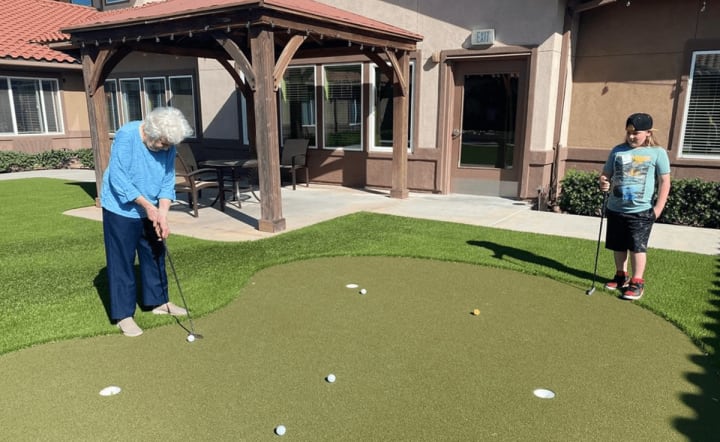
This Vineyard Place Memory Care resident shows off her putting skills to a visiting student in Murrieta, California.
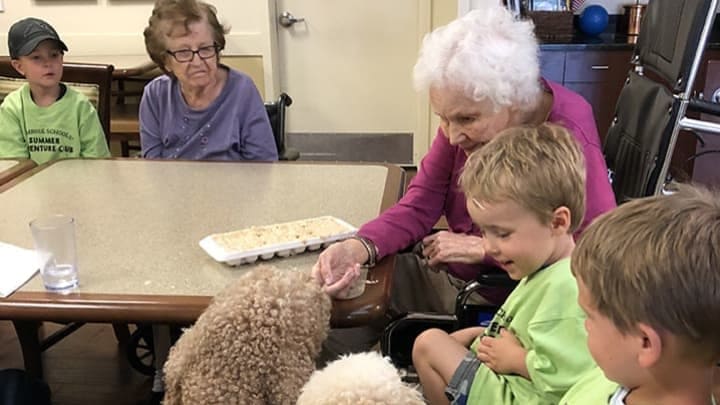
Local school children visit residents (and canine friends) of Willowbrook Place Memory Care in Littleton, Colorado.
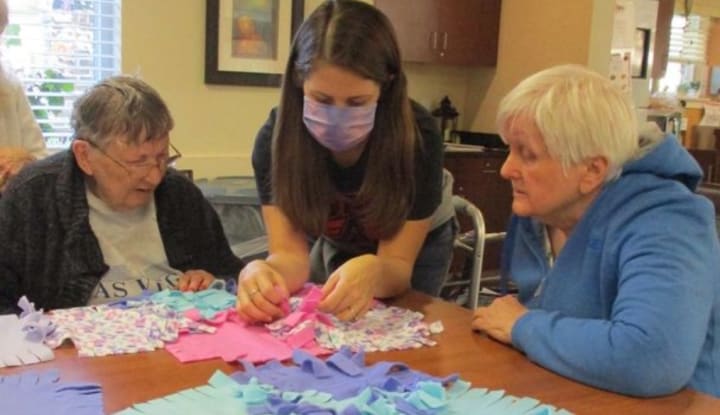
A special Day of Service project is shared between residents of Harvester Place Memory Care and local high school students in Burr Ridge, Illinois.
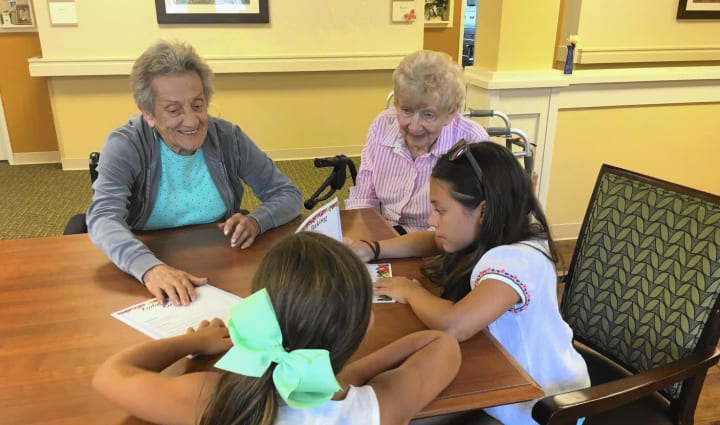
Highline Place Memory Care residents swap some recipes with local schoolgirls in Littleton, Colorado.
We are grateful for our partnerships with local schools and organizations who support our inter-generational programs. They are an important part of our mission to protect, engage, and love our residents.
If you are caring for a loved one who has dementia, consider getting in touch with family members or close friends who have children who might be up for a visit. Be sure to brief them so that they understand your loved one's challenges in advance of the visit. But, by taking a few extra steps to connect your loved one with young people you just might find that the benefits are well worth the effort.
(Our header image shows a fun game of cards being enjoyed by a resident of Chelsea Place Memory Care and a student from Regis Jesuit High School in Aurora, Colorado.)
What better way to wrap up a wonderful summer than a luau! Vineyard Place residents, staff and families enjoyed delicious Hawaiian food, music, and dancing. Local Hawaiian dancers put on a great show with some free Hula lessons included. Everyone enjoyed the day and look forward to doing it again next year (if not sooner)!
The event was covered in the local Murrieta Patch. You can read the story here:
https://patch.com/california/murrieta/murrieta-seniors-celebrate-end-summer-luau-nodx
Every September Alzheimer’s Disease International publishes a report on the research conducted over the last year. While we wait for this years’ report, The 2022 World Alzheimer Report has several interesting statistics and insights from their annual survey that deserve attention. At Anthem Memory Care, we believe it is important to help everyone better understand the disease and, for those who have been diagnosed, navigate the challenges of the road ahead more effectively.
Here is the latest global data on dementia:
What does this tell us? It shows that there is still more work to do, from education on the disease itself, to treatment, to better support and resources for individuals with dementia and those who care for them.
Fortunately, the Alzheimer’s Association continues to be a prime source of information to help everyone educate themselves and to be more prepared in the event a loved one is diagnosed with dementia. Here are a few of their resources:
The most important thing to understand is that “waiting” is not a good strategy. If you suspect that a loved one may be in the early stages of dementia, now is the time to take action. Arming yourself with information from trusted resources is a good start. And remember, our Anthem Memory Care communities are always ready and willing to answer your questions and address your concerns. Reach out to us. We’re here to help.
Related Articles:
Family members of individuals with dementia will often tell us that they sometimes feel they must re-learn basic communications skills to connect with their loved ones.
In many ways that is true. Because the rules have indeed changed. You may no longer be able to rely on the kind of casual back and forth banter that was part of your family vernacular for years.
The first step is to make peace with the fact that things have changed. The next step is to develop new communications skills that respond to your loved one’s changing cognitive state while respecting their place and stature in your family. Doing so will maximize your loved one’s ability to understand you and respond accordingly.
Here are five tips:
As you work to apply these tips to yourself, don’t forget to share them with family and close friends so that they, too, can experience the benefits as well.
This is without a doubt a challenging journey. But by discovering new, more productive ways to communicate with your loved one, you can retain more of the relationship you once treasured, while forging a new one that, with patience, can lead to more moments of joy.
Dog lovers unite! At Liberty Place Memory Care, residents are always looking for ways to give back to the greater community. And when their activities can help their canine friends at local shelters, all the better! As part of their "Dog Days of Summer" week long celebration of dogs, residents and staff partnered with Angel's Paws, a local dog hospice organization, putting together small individual "doggie bags". The fun continued with visits from therapy dogs, dog trivia and lots of other activities.
Dog Days of Summer was covered in the local Warren County Post. You can read the full story here:
https://warrencountypost.com/g/mason-oh/n/209343/making-best-dog-days-summer
We often hear from family caregivers who are overcome with guilt and worry when a loved one with Alzheimer’s falls and breaks a hip or fractures a knee. “Why did I let him go and get the mail?” “Why did he get up when I asked him not to?”
If you’ve experienced the fall of a loved one, instead of blaming yourself (or them), it’s time to put the blame where it belongs, on the real culprit: your loved one’s brain.
Dementia manifests itself in a multitude of cognitive and physical issues that work against an individual attempting to do simple things he or she did all their lives. That includes walking.
What’s happening?
Dementia causes damage to the motor and premotor cortex, the limbic system, and the basal ganglia of the brain. All of these areas must work together collectively to coordinate signals from the brain to the muscles to carry out the complex network of movement involved in doing things like standing up, sitting down, turning around and walking.
When dementia impairs these processes, the result is often a fall.
And when a fall does occur, an individual with dementia is six times more likely to suffer a broken bone than a healthy aging adult. In late-stage dementia, a spiral fracture is more likely, which can result in a broken hip. Unfortunately, that will lead to a hospital stay, quite possibly an end-of-life event.
One thing that you may not realize is that falls can differ depending on the type of dementia an individual has.
Different types of dementia can impact movement and strength differently.
The nature and direction of the fall may differ depending on the type of dementia. Here are a few examples from the National Institute on Aging and the Itty Bitty Dementia Book by Tam Cummings:
The more you know the better prepared you can be.
Of course, it’s impossible to be at your loved one’s side 24/7 and important to remember that falls will most likely happen at some point. But here are some tips from our Anthem Memory Care communities to help safeguard your loved one from taking a bad fall:
When the potential for falls increases, it’s time to consider memory care.
Memory care communities tailor their programs and care regimens to meet the unique challenges of individuals with dementia. Memory care professionals are well aware of the link between memory loss and mobility issues that can heighten the risk of a fall. That is why their buildings include mobility aids as well as visual cues to help mitigate arising issues that could precede a fall. Built-in features may include handrails, color coded pathways, signage, and flooring with non-glare coating.
The memory care staff is highly trained to provide specialized care to individuals with dementia in the form of assistance with activities of daily living and mobility support. While there is never a guarantee that a fall will not happen, working with residents on a daily basis to optimize their physical strength and balance can help reduce the likelihood of a fall or lessen the severity of an injury resulting from a fall.
Feel free to contact an Anthem Memory Care community near you. We’ll be glad to answer your questions and schedule a tour. We’re here to help!
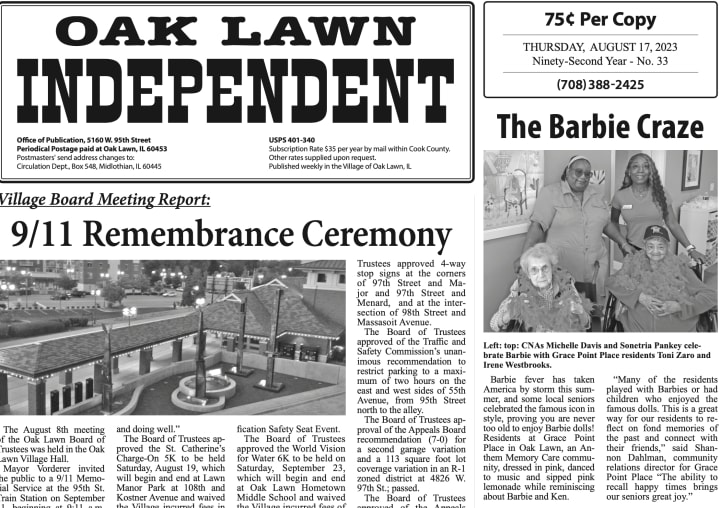
It seems like ever since the movie came out, Barbie Doll lovers have been re-living their childhoods. And the residents and staff of Grace Point Place are no exception. They recently hosted a "Barbie Party" complete with Barbie glam and fun food and drinks. Lots of pink was on display! Shannon Dahlman, community relations director for Grace Point shared her thoughts with the Oak Lawn Independent. "Many of the residents played with Barbies or had children who enjoyed the dolls," she said. "This is a great way for our residents to reflect on fond memories of their past and connect with their friends," she added.
Below is an image of the article as it appeared in the Oak Lawn Independent: