
We all know that old postcards, newspaper clippings and photographs are almost guaranteed to spark memories, often about things we thought we had forgotten. The ability of mementos to unlock old memories can be especially powerful for those who live with Alzheimer’s disease.
At our Anthem Memory Care communities, we enjoy learning as much as possible about the lives of our residents and work with family members to keep memories alive. We also encourage family members to organize their loved ones’ mementos and photographs in a manner that makes them quickly accessible. These “memory boxes” of treasures collected over the years typically include items that have developed special meaning to family and friends. If you are a family caregiver, you might consider creating a memory box for your loved one with dementia. They are not difficult to put together and the smiles they bring are well worth the effort.
The Mayo Clinic covered the topic of memory boxes and had a few good suggestions we thought we’d share:
There are almost unlimited sources for items to include in your loved one’s memory box. Consider important papers, certificates, personal letters and greeting cards collected over the years. And you will want to add to your memory box as you uncover more treasures.
Remember, the key is to keep your memory box (or boxes) in a place where it is easily retrieved, so don’t keep it locked away or stored in a closet. Items that spark memories for a loved one with dementia deserve a place right in the center of activity. You will find yourself pulling their memory box out often and you and other family members will grow to appreciate its ability to connect you to your loved one, enjoying every precious memory that remains intact.
Have you ever been more thrilled to see spring finally arrive? We certainly are! Of course, in some of our communities, we’re still waiting (impatiently) for the last bits of snow to melt and more sunlight to flood our courtyards. But spring is officially here and we’re eager to make the most of it.
Warmer weather and more sunlight are, of course, beneficial for everyone, but especially for those living with dementia. Long winter days of stormy, cold weather can lead to depression and increased anxiety. When the sun comes out, even for a few minutes, its ability to so quickly lift the spirits and improve morale is amazing.
There is a good reason for this. Studies have shown that fresh air and sunlight can improve oxygen flow to the brain. This increases awareness and can sharpen cognition. Direct sun improves mood and can lead to healthier sleep patterns as well. And warm breezes, along with birds and flowers stimulate the senses, which can help reduce anxiety and restlessness.
At Anthem Memory Care communities, we are big believers in adding as many outdoor experiences for our residents as possible. That’s why we’ve designed our buildings to provide lots of opportunity for residents to safely explore outdoor areas and gardens. And, of course, we all love a good game of croquet or sharpening our skills on the putting greens.
We’re looking forward, as the weather warms up, to sharing even more photos like these:
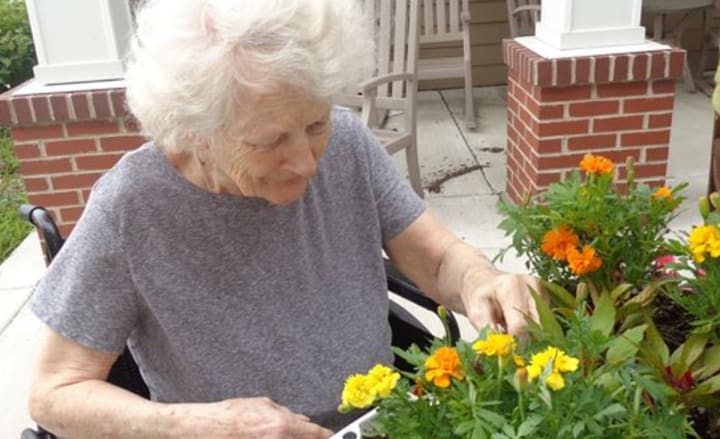
Gardening at Grace Point Place…
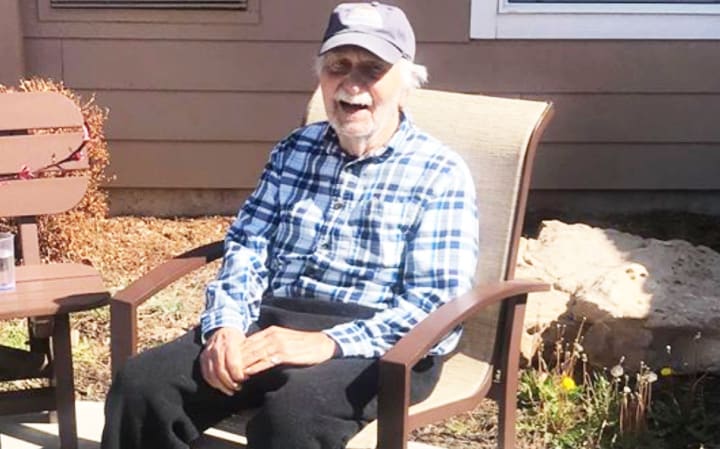
Soaking up some rays at Willowbrook Place…
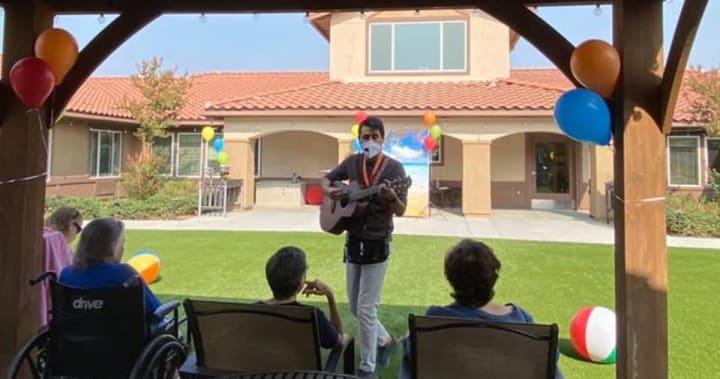
Outdoor serenade in the courtyard at Vineyard Place!
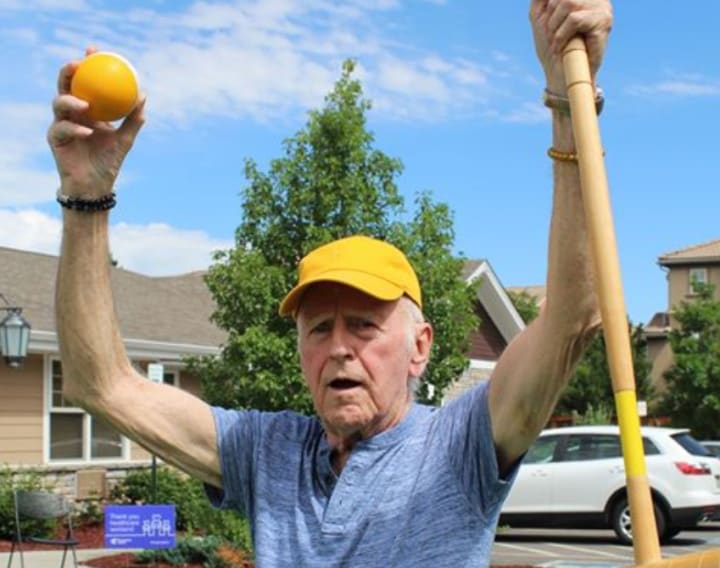
This Chelsea Place croquet match has a winner!
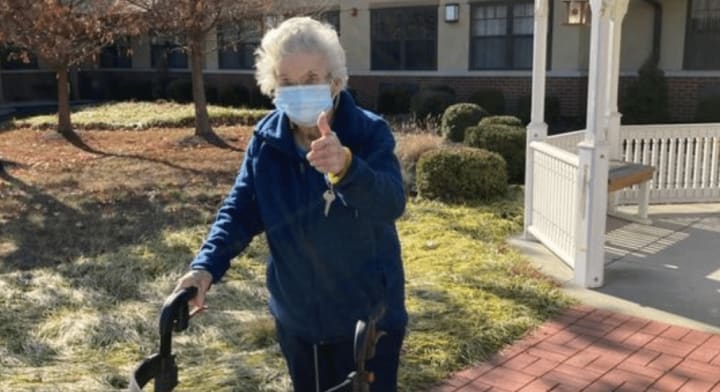
The weather gets a big thumbs up from this resident of Morningside Place.
As we look forward to warmer days ahead, we look forward to more time spent enjoying them. If you care for a loved one who is living with dementia, even if they have never been known as an “outdoor person” try to arrange for activities that are conducive to being outside, whether it’s a short walk or sitting with a book or magazine. The more fresh air and sunshine, the better.
By the way, that goes for caregivers too. Why not join them?
(The image at the top of this blog is of a resident of Porter Place Memory Care at his favorite fishing hole!)
Related Articles:
As we continue to heal and rebound from the challenges of the pandemic, we are all on the lookout for activities and events that will bring a smile and, hopefully, even some laughter into our lives.
Chelsea Place Memory Care in Aurora Colorado seized an opportunity to do just that. It came in the form of a visit by Mark Hall, a talented local caricature artist.
Now, if you’ve ever had your caricature done, you know how fun the process is, as the artist proceeds to build out a humorous portrait, accentuating your (best and worst) features, often eliciting comments such as, “I don’t look like that….do I?” Having your own caricature done or watching the artist sketch others seldom fails to bring out the good-humor and fun in everyone.
To conform with CDC health requirements, Mark Hall positioned himself outside on the Chelsea Place patio while residents came out, one by one, to have their portraits sketched. All agreed that the results really captured the residents’ unique personalities. It was a fun day that got all the Chelsea Place residents and staff talking and chuckling at themselves and each other.
Below is a composite of three amazing caricatures…
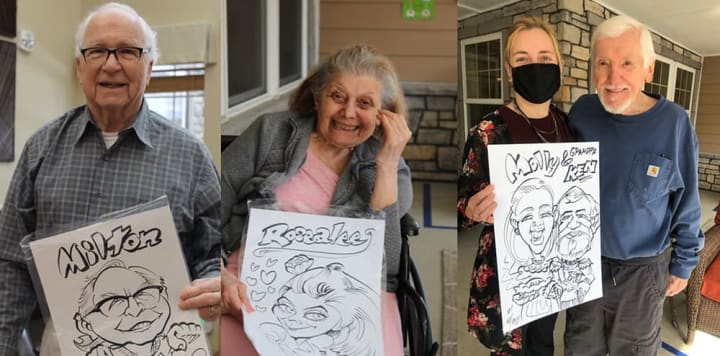
Molly, on the far right, is Chelsea Place’s new life engagement assistant. That’s Ken, her grandfather, on her right. Ken is a resident of Chelsea Place!
The event was covered by a reporter from local TV station, KDVR, who interviewed life engagement director, Jenni Dill right before Mark began his work. “With pandemic safety protocols still in effect, he can’t come inside and meet the residents before sketching them,” she told the reporter. “We think with this approach and his talent, he will be able to create compelling portraits that convey the fullness of each person.”
He certainly did!
Related Articles:
March is National Nutrition Awareness month, which puts a much-needed focus on the foods we eat and what those foods do to help or hinder our physical, cognitive and emotional health. For individuals living with dementia, nutrition holds special importance, in that we now are more aware of the power of nutrients to optimize cognitive health. So, infusing diets with these nutrients can make a difference in how well an individual can retain mental acuity, memory and other areas of health as they relate to cognition.
What are these nutrients and how can those of you caring for loved ones with dementia ensure that they receive the benefits of them?
The Alzheimer’s Association has published guidelines specifically geared to support those living with dementia and help them gain optimum nutritional value in the foods they eat.
Here are a few things to keep in mind that we hope you will find useful:
Individuals with dementia, especially in the mid to later stages of the disease, can quickly become overwhelmed with having too many food choices, immobilizing them and leading to either not eating or reaching for a fast and easy (and often not healthy) food choice. They may also simply forget to eat or believe they have already had a meal. All of these issues can lead to malnutrition, lacking key vitamins and minerals their bodies need to function properly.
If you are caring for a loved one who lives with dementia, take the time to evaluate their daily food intake. Take notes of what they eat, along with what their taste preferences are. Then you can begin to design a daily menu that will be appealing to them, while satisfying their daily nutritional needs.
For family caregivers of loved ones with dementia who live remotely, these have been especially challenging times. Not only has the pandemic made travel more difficult, it has managed to add to the already high anxiety and stress levels felt by family members who cannot be with their loved ones during these times.
If you have an aging parent or other loved one who has been recently diagnosed with dementia and are not able to live close to them, it’s important to know that there are things you can do to be better prepared to care for them.
Here are three tips for long distance caregivers to help narrow the distance gap between you and your loved one:

At Anthem Memory Care communities, our residents keep in close touch with family members tablets and other technologies to connect and visit virtually. The resident shown above is enjoying a lovely guitar serenade from a family member during a meal at Chelsea Place Memory Care in Aurora, Colorado.
Finally, consider reaching out to memory care communities local to your loved one. While you may not be ready yet to make decisions about memory care, they should have resources to help you connect to services you need today. Our staff at Anthem Memory Care communities is always available to talk with you, provide local information and help you prepare for the journey ahead.
While you may be physically removed from your loved one, being organized with all the documents and information you need and using the many resources available to you can help enormously. And remember, we’re always here to help!
Related Articles:
Recently, members of Boy Scout Troop 64 in Glenview, Illinois took their snowman-making talents to Emerald Place Memory Care. The result was a virtual village of snow people strategically located in front of the windows of delighted residents.
“Everyone needs a little bit of happiness; a little bit of light in their lives,” one of the scouts told the local Chicago CBS reporter who covered the project.
You can watch the full CBS coverage here:
https://chicago.cbslocal.com/2021/02/20/boy-scouts-snowmen-glenview-memory-care-center
Related Articles:
When Mia walks through the doors of Chisholm Place Memory Care in Wichita Kansas, everyone smiles.
Mia is a German Shepherd mix and an official therapy dog, loved by just about everyone she comes into contact with. And there is a good reason for this. Animals bring with them a natural form of therapy that seldom fails to bring out smiles and laughter. This is especially true for those living with dementias, such as Alzheimer’s disease. Many of our own residents have owned pets at one time or another in their lives. Engaging with animals can often spark a memory or too, along with the joy of the interaction itself.
That is one of the reasons our Anthem Memory Care communities work with local animal therapy organizations to bring these wonderful 4-legged visitors through our doors.
Karin Winegar, author of “Saved: Rescued Animals and the Lives They Transform” once remarked that “The human-animal bond bypasses the intellect and goes straight to the hear and emotions, and nutures us in ways that nothing else can.”
While this is certainly true, there are more tangible benefits of those interactions as well. To name a few:
We’d like to share with you just a few of those interactions:

Lily the cat gets love from a resident of Willowbrook Place Memory Care in Littleton, Colorado.

Here’s Mia, basking in some TLC from a staff member and resident of Chisholm Place Memory Care in Wichita, Kansas.

This sweet Poodle mix is dressed for the holidays at Porter Place Memory Care in Tinley Park, Illinois.
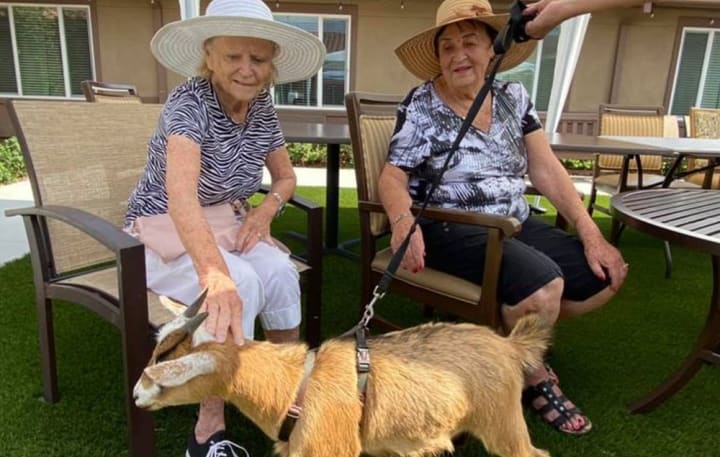
Residents of Vineyard Place Memory Care in Murrieta, California, enjoy the occasional goat visit. And why not? They are clean and very sociable!
If you are caring for an aging loved one who struggles with dementia, consider bringing a trusted family dog or cat in for a short visit. Of course, it’s important to make sure that the animal is well behaved and clean, both key to making the visit a positive one. You may be surprised, when a beloved pet walks through the door, how quickly your loved one’s eyes light up. Animals just have a way of doing that, we’ve found.
Dr. Edward Creagen of the Mayo Clinic once remarked about the value of animals, saying “If pet ownership was a medication, it would be patented tomorrow.” We certainly agree!
(The header image is of “Amos” with a resident of Willowbrook Place Memory Care.)
Related Articles:
Residents and staff of Chelsea Place Memory Care in Aurora, Colorado got together with family and friends to hold a Valentine’s Day car parade. Staff lined up outside the front entrance and residents watched from the safety and warmth of the lobby as a steady stream of brightly decorated cars made their way past the enthusiastic group. (The header image is courtesy of CBS, Denver)
The parade was covered by the local CBS channel in Denver as well as The Sentinel, the area’s local paper. You can watch the video here:
https://denver.cbslocal.com/2021/02/16/aurora-regis-jesuit-car-parade-seniors/
You can read more about it here: https://sentinelcolorado.com/orecent-headlines/valentines-day-parade-a-sweet-respite-from-aurora-elder-care-center-isolation/
Residents and staff of Grace Point Place are always looking for ways to give back to the greater community. Recently the residents made dozens of beautiful valentines to give to the local Oak Lawn fire department. They were surprised and thrilled to receive them.
The event was covered by the local CBS station in Chicago. You can watch the video here.
The long, cold months of deep winter can be especially challenging for those living with dementia. If you have a loved one with dementia, especially if they live alone, these challenges are even greater. Why is this? There are several reasons. Here are a few:
Dealing effectively with these issues begins by recognizing them. Understanding potential reasons why mom seems especially depressed is part of the battle. The other part lies in finding ways to counteract the negative impact of winter months on your loved one’s physical, cognitive and emotional wellbeing.
Here are a few tips to help your loved one get through these months and help improve your own health and outlook as well:
Residents of Anthem Memory Care communities engage in daily activities, including exercise, art, music and reading to keep them engaged and connected to those around them. We also encourage short walks in our courtyard, weather permitting, because we know that even a few minutes of fresh air has a therapeutic impact during the winter months.
Recognizing the challenges that winter brings to the health and wellbeing of a loved one with dementia and taking steps to minimize its negative impact will make these long winter days a bit easier to bear. And, before we know it, spring will be in the air once again!
(The top image is of a resident of Highline Place Memory Care in Littleton, Colorado showing off her lovely flower arrangement.)
Related Articles:
Most of us remember being back in elementary school and the eager anticipation of getting a valentine from someone in our class. In we’d walk, with a bag full of our own valentines to hand out. And, inevitably, there would be that one valentine we’d receive without the giver’s name, leaving us to ponder who it came from.
The fun associated with receiving an anonymous gift is something we enjoy even in our older years. Whether it is a bouquet of flowers, a “secret Santa” gift, or a card on Valentine’s Day, these small, unexpected surprises have a way of lifting our spirits and adding a little joy to the day.
Can receiving a surprise valentine elevate your mood? Yes!
The staff and residents of Grace Point Place Memory Care in Oak Lawn, Illinois are out to create some of their own Valentine’s Day surprises with their Secret Valentine’s program. Residents have designed their own valentines to hand out to local Oak Lawn fire fighters and other first responders. And, members of the greater community are invited to send valentines to residents to brighten up their Valentine’s Day.
Pleasant surprises, by the way, are good for us, according to Tania Luna and LeeAnn Renninger, authors of “Surprise: Embrace the Unpredictable and Engineer the Unexpected”. The book cites studies that break down what they refer to as the “science” of surprise. Results indicate that a pleasant surprise can trigger the release of dopamine, a chemical that can, according to Luna, stave off bad feelings. “When we invite surprise into our lives on a regular basis, we elevate our mood,” she says. And, according to studies she cites, it helps build a greater tolerance for “uncertainty” which can help reduce anxiety, especially helpful to those living with dementia.
Secret Valentine’s Day cards give memory care residents something to look forward to.
So, there appears to be some real science behind the pleasant surprise associated with receiving a secret valentine. And, for residents of Grace Point Place, the fun of anticipating these secret valentines adds a layer of anticipation to Valentine’s Day and something to look forward to.
At Anthem Memory Care communities, we are always looking for ways to bring joy into the lives of our residents and staff members. If you are caring for an aging loved one, consider surprising him or her with a spontaneous gift of flowers, a plant, or a mailed card or note. You may be surprised yourself at how much joy that simple act brings to you as well as your loved one.
Wishing you a happy Valentine’s Day.
(In the top image, Shirley, a resident of Grace Point Place, takes a break from designing valentines to pose with a lovely smile in front of the Secret Valentine poster.)
Related Articles:
When we think of February, most of us think of Valentine’s Day. So, hearts are on many of our minds this month. But did you know that February is American Heart Month?
Heart health is important for so many reasons. However, you may not be aware that studies have shown a relationship between heart health and cognitive health. So, among other advantages, a healthy heart can reduce the potential for developing dementia later in life.
And, for those who are living with dementia, improving heart health can help optimize their cognition levels as well. Why is this? According to a study published in the Journal of the American College of Cardiology, there may be a link between the plaques built up in the brain to similar plaques in the heart.
That’s why it’s so important for individuals living with dementias, such as Alzheimer’s disease, to get regular exercise and fresh air to keep their brains oxygenated and working to their best ability.
With that in mind, here are 5 keys to better heart health that all of us should do our best to adhere to:
At Anthem Memory Care communities, our mission to protect, engage and love our residents extends throughout their daily lives, including regular exercise, fresh air, brain healthy foods and an environment that encourages connection with the world around them.
If you are caring for a loved one with dementia, be sure to reach out to the many resources that are available to you. We have some excellent resources posted here to help you on your journey to keep your loved one, yourself and your family healthy.
(The top image is of one of the amazing residents of Chisholm Place Memory Care in Wichita, Kansas.)
Related Articles:
Many of you may recall the startling Brigham Young University study, a few years ago, which found that loneliness and social isolation can be as damaging to elderly adults as smoking 15 cigarettes per day. While that finding may be hard to accept, there are other studies that support a connection between isolation and serious health issues.
Another study conducted by the University of Michigan found that 56% of seniors living alone reported feeling isolated. That’s almost double the percentage reported back in 2018. And, according to the U.S. Census Bureau, almost 13 million seniors currently live alone. So, putting those numbers together reveals a troubling pattern. And the pandemic has only made it worse.
While we are optimistic that vaccinations will eventually lead to opening doors for visits and more physical interactions, we’re not there yet. The CDC warns us that all the safety precautions initially put in place must continue to be followed until we have a sufficient percentage of the population vaccinated.
So, if you are an adult child of a parent who lives alone, you are undoubtedly feeling immense pressure to find ways to stay connected with your loved until the day when you can be there in person. Fortunately, there are things you can do to create and sustain that connection.
Here are 5 tips to get you started:
Use your imagination to find more ways to stay as tuned in as possible. Encourage input from other family members. Children often have the most creative ideas.
Remember to end each call or virtual visit by reassuring your loved one that the pandemic won’t last forever and that you will all be together again soon. Talk about birthdays to come and plans for future celebrations. You will find that keeping in touch in this way will benefit your own emotional and physical health as well.
Related Articles:
One of the best things about 2021, so far, has been the roll out of COVID-19 vaccines. We are currently in the process of vaccinating our residents and staff members at all of our Anthem Memory Care communities.
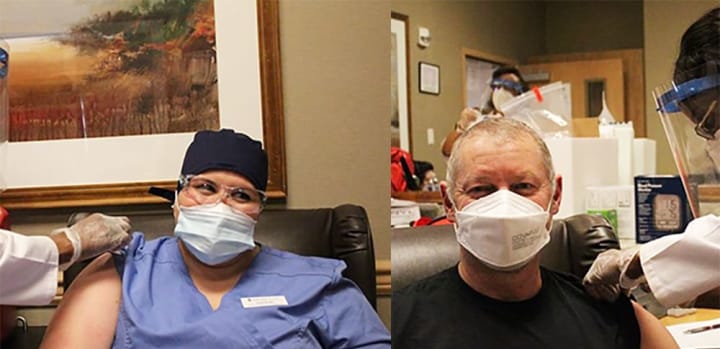
Staff and residents are receiving their COVID-19 vaccinations!
It is so important, now more than ever, to make sure you have all the latest facts on COVID-19 and the roll that vaccines are playing in protecting all of us, especially those most vulnerable to the disease. Here are some key points from the CDC (Centers for Disease Control and Prevention) that bear noting:
There is much more information on COVID and vaccinations on the CDC website, which you can access here.
Regardless of whether you are an adult child, caring for an aging parent, or you are young and live by yourself, it’s important to stay current as to the status of the pandemic and availability of vaccinations. And, don’t forget to do your part to stay safe, by wearing a mask and practicing social distancing.
We are all looking forward to the days when our families can once again come through our doors and hug their precious loved ones again! In the meantime, our amazing caregiving heroes inside our Anthem Memory Care communities continue to follow their passion and honor their commitment to protect, engage and love all of our wonderful residents.
If you have a loved one living alone or in assisted living or memory care, you have probably found yourself focused this last year almost exclusively on checking in on them to make sure they are being kept as healthy and safe as possible. It’s been a roller coaster of a year and the pandemic has done a good job of shaking up everyone’s nerves and confidence in doing simple things like going to the grocery store or dentist.
All this concentration of worry and anxiety has caused many adult children to neglect their own health. Perhaps you have gained weight, put off check ups and dental visits and acquired all sorts of other unhealthy habits that, over time, can have a serious negative impact on health.
Now that we’re into a new year, it’s time to get in gear and do an inventory of where you are today and what you can do to help restore good health to yourself and your family.
A great place to start is by doing a health self-audit. Here are four questions to ask to check in on your own health:
At Anthem Memory Care communities we are continuing to take all the precautions recommended by the CDC and are working hard to make sure our residents and staff stay healthy. We feel we are closer every day to our goals of a COVID-free world which only deepens our resolve to protect, engage and love our residents.
Please feel free to contact us at any time to discuss your challenges and concerns. We are dedicated to serving, not only our residents but families as well. Our advice to all families of individuals in senior care is to stay informed, get involved and work on optimizing your own health!